

Unknown data issues—like schema drift, silent truncation, and unexpected distribution shifts—go undetected by standard validation rules, unlike known problems such as missing values or duplicates. This post explains how schema drift alone accounts for 70% of data pipeline failures, causing silent ETL failures, broken dashboards, and compliance risks. It outlines seven metrics to measure drift impact and a strategic framework—centered on data observability, schema diff automation, and centralized DQ catalogs—to convert unknown issues into detectable, manageable ones.
Key Takeaways
- Unknown issues differ fundamentally from known data quality problems — schema drift, distribution shifts, format inconsistencies, and silent truncation aren’t caught by standard validation rules and often go unnoticed until real damage occurs.
- Schema drift causes the majority of pipeline failures — accounting for 70% of failures, with organizations spending roughly 40% of development cycles on data-related rework due to late detection.
- Seven metrics quantify drift impact — including drift frequency, detection latency, pipeline failure rate, data loss rate, test case failure rate, business impact score, and schema compatibility score.
- Data observability shifts detection from reactive to proactive — continuously monitoring metadata changes, logging drift in a DQ catalog, alerting stakeholders, and mapping downstream dependencies before failures cascade into dashboards, compliance systems, or ML models.
In a world where data drives every decision, the biggest threats often come from what we don’t see. Most data teams are fighting yesterday’s war. While they chase missing values and duplicates, the real destroyers are already inside their systems, invisible and multiplying. Which is why organizations must invest in monitoring unknown data issues to safeguard their systems from silent failures and costly disruptions.
Data Quality (DQ) issue management teams build validation frameworks to tackle known problems—missing values, duplicates, or format mismatches. But, the severe disruptions happen from unknowns like the schema changes no one anticipated, the column length tweaks that quietly break downstream systems, or the unexpected nulls that derail test cases? These are the data disasters waiting to happen.
What Happens When Unknown Data Issues Go Undetected
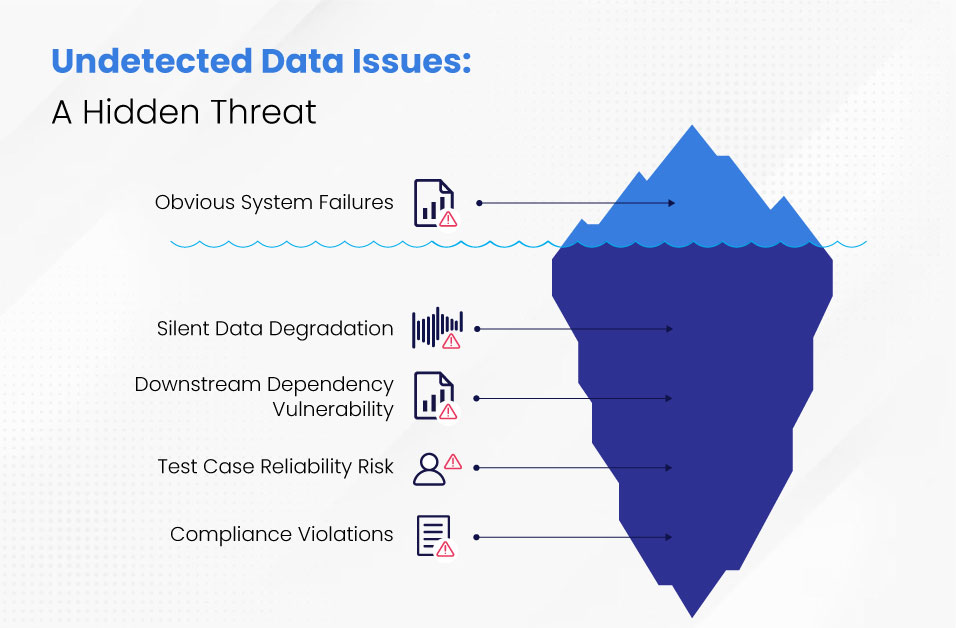
1. Silent Failures Are the Most Dangerous
Unlike obvious system failures, these degradation patterns erode trust one decision at a time, compounding damage across every downstream process that relies on compromised data.
2. Downstream Dependencies Are Vulnerable
Modern data ecosystems are deeply interconnected. A single schema change in one source can propagate through rest of the systems breaking ETL pipelines, corrupting dashboards, and derailing machine learning models.
3. Test Case Reliability Is at Risk
“How to prevent test case failures due to schema drift?” The answer lies in early detection. If a column is modified and this change isn’t flagged, entire test suites can fail, delaying releases and increasing costs.
Organizations spend 40% of their development cycles on data-related rework because they detect structural changes after damage occurs, not before it spreads.
4. Compliance Is Non-Negotiable
In regulated industries like banking and healthcare, data integrity isn’t optional. Unknown issues can lead to non-compliance, audit failures, regulatory penalties and reputational damage that can end careers and close divisions
What Are Unknown Data Issues?
Unknown data issues are anomalies that occur without immediate detection. Unlike traditional data quality problems, they’re not flagged by standard validation rules and often go unnoticed until they cause real damage. These can include:
- Schema drift (e.g., column renaming, type changes)
- Unexpected data distribution shifts
- Format inconsistencies
- Silent truncation due to column length mismatches
Unpacking unknown issues through schema drift
While unknown data issues include distribution shifts, format inconsistencies, and silent truncation, schema drift represents the most common and impactful category affecting 70% of data pipeline failures. The monitoring approach we’ll outline applies universally, but we’ll use schema drift as our primary example since it illustrates the broader detection challenge facing modern data teams.
Let us consider 2 examples
Example 1: Column Length Expansion
A source system increases email field length from 50 to 100 characters. Your data warehouse still expects 50 characters, causing silent truncation that corrupts customer records without generating alerts.
Example 2: Field Renaming
The field name 'email' changes to 'user_email', breaking transformations across multiple systems
Original Data (Day 1)
json
{
“customer_id”: “C123”,
“name”: “Ravi Kumar”,
“email“: “ravi.kumar@example.com”,
“signup_date”: “2025-01-10”
}
Drifted Data (Day 45)
json
{
“customer_id”: “C123”,
“name”: “Ravi Kumar”,
“user_email“: “ravi.kumar@example.com”,
“signup_date”: “2025-01-10”
}
What Goes Wrong
- Your ETL pipeline is configured to extract the email field. Since it no longer exists, the pipeline either:
-
- Skips the record entirely
-
- Inserts a null value for email
-
- Fails silently, depending on error handling
- Downstream systems like CRM or marketing tools that rely on email for communication or segmentation now receive incomplete customer profiles.
- Dashboards showing customer engagement metrics display blanks or drop users from email-based filters.
- Compliance systems tracking consent miss critical records when fields disappear, risking regulatory violations.
- Cross-team collaborationbreaks down as data engineers spend significantly more time troubleshooting pipeline failures while business analysts lose trust in reports when metrics suddenly drop without explanation, creating a cycle of emergency audits and manual reconciliation work that consumes both teams’ strategic capacity.
Metrics to Measure Schema Drift Impact
| Metric | Definition | How It’s Measured |
|---|---|---|
| Drift Frequency | How often schema changes occur in source systems | Number of schema changes per month or per data source |
| Drift Detection Latency | Time taken to detect schema drift after it occurs | Average time between drift occurrence and detection |
| Pipeline Failure Rate | Percentage of ETL jobs or pipelines that fail due to schema drift | (Failed jobs due to drift / Total jobs) × 100 |
| Data Loss Rate | Volume or percentage of data lost or corrupted due to schema mismatches | (Lost or malformed records / Total records processed) × 100 |
| Test Case Failure Rate | Number of test cases that fail due to schema inconsistencies | (Drift-related test failures / Total test cases) × 100 |
| Business Impact Score | Weighted score based on affected KPIs (revenue, customer experience, compliance) | Custom scale (1–10) based on severity and scope |
| Schema Compatibility Score | Degree of backward/forward compatibility support | Score based on schema registry validations |
1. Drift Frequency
Definition: How often schema changes occur in the source systems.
Metric: Number of schema changes per month or per data source.
2. Drift Detection Latency
Definition: Time taken to detect schema drift after it occurs.
Metric: Average time (in hours or days) between drift occurrence and detection.
3. Pipeline Failure Rate
Definition: TPercentage of ETL jobs or data pipelines that fail due to schema drift.
Metric: (Failed jobs due to drift / Total jobs) × 100
4. Data Loss Rate
Definition: Volume or percentage of data lost or corrupted due to schema mismatches.
Metric: (Lost or malformed records / Total records processed) × 100
5. Test Case Failure Rate
Definition: Number of test cases that fail due to schema inconsistencies.
Metric: (Drift-related test failures / Total test cases) × 100
6. Business Impact Score
Definition: Weighted score based on affected KPIs (e.g., revenue, customer experience, compliance).
Metric: Custom scale (1–10) based on severity and scope of impact.
7. Schema Compatibility Score
Definition: Degree to which the solution supports backward and forward compatibility.
Metric: Score based on schema registry validations or compatibility checks.

The Solution: Proactive Schema Detection Through Data Observability
Traditional data quality monitoring operates reactively alerting after problems occur. The solution lies in shifting to proactive detection that monitors metadata changes continuously, transforming schema drift from an invisible threat into a manageable operational process
Two core solution components address the detection gaps:
1. Monitoring via Data Observability dashboards
2. Maintaining schema registry
Section: Implementing Data Observability as your Solution
Data Observability becomes your safety net as it continuously monitors data health, metadata changes, lineage, and anomalies across the entire lifecycle.
When a column changes in source files, a robust observability platform would:
- Detect the schema drift instantly
- Log it in the Data Quality catalog
- Alert stakeholders
- Map all downstream dependencies
- Pause or reroute test execution to prevent failures
This proactive approach transforms unknowns into manageable knowns giving teams the visibility they need to act before damage occurs.
Solution Impact: Before vs. After Implementation -Schema Drift
Without observability:
- A column is renamed in the source system
- ETL jobs fail silently or produce incorrect results
- Dashboards show blank fields and misleading metrics
- Test cases fail unexpectedly, delaying releases
With observability:
- The change is detected and logged within minutes
- Impact analysis identifies affected systems
- Teams implement fixes before production deployment
- Downstream systems receive clean, consistent data
A Strategic Framework for Proactive Data Issue Management
Effective schema drift management requires systematic implementation across several operational domains. Applied consistently, this approach transforms data from an operational liability into a strategic asset that organizations can depend on for critical decision-making.

1. Adopt Data Observability Tools
Implement platforms that offer real-time monitoring, schema drift detection, and anomaly alerts. These tools act as your early warning system.
2. Integrate detection with Test Automation
Connect test automation frameworks directly to data quality catalogs. If a schema change is detected, test cases should be flagged or paused automatically.
3. Schema Diff Automation
- Run automated schema difference checks between environments (e.g., dev vs prod) before test execution.
- Flag and isolate tests that depend on changed fields.
4. Maintain a Centralized DQ Catalog
Track all known and unknown issues, schema changes, and resolution history in one place, as part of an ongoing data quality testing practice. This becomes your single source for data reliability.
5. Conduct Impact Analysis
When changes are detected, assess which systems, reports, or models are affected. This helps with prioritizing fixes and avoiding surprises.
6. Establish Governance Protocols
Define clear workflows for handling schema changes, including approvals, rollback mechanisms, and communication plans.
Final Thoughts – The Path Forward
Monitoring unknown data issues isn’t just a technical best practice. It is a strategic imperative. In a data-driven world, the cost of ignoring silent anomalies can be catastrophic. Just like insurance protects us from the unexpected, data observability protects our systems from silent data failures.
The choice is clear: implement proactive data observability frameworks with robust detection capabilities now, or continue discovering failures through customer complaints and broken dashboards
FAQs: Schema Drift and Data Observability
1) What are “unknown data issues” and how are they different from typical data quality problems?
Unknown data issues include schema drift, unexpected data distribution changes, format inconsistencies, and silent data truncation. Unlike common data quality problems such as null values or duplicate records, these issues often bypass predefined validation rules and remain undetected until they disrupt downstream pipelines, reports, or business processes.
2) What is schema drift and why does it matter?
Schema drift occurs when a data schema changes unintentionally—for example, when a column is renamed, removed, or its data type changes. Unlike planned schema evolution, schema drift can silently break ETL pipelines, produce inaccurate dashboards, interrupt data integrations, and create compliance risks if not detected early.
3) How can organizations detect schema drift before it causes damage?
Data observability continuously monitors metadata throughout the data lifecycle to detect schema changes as they occur. It alerts stakeholders, records changes in a data quality catalog, identifies downstream dependencies, and can pause or reroute testing workflows to prevent widespread failures.
4) What metrics help measure the impact of schema drift?
Organizations commonly track metrics such as drift frequency, detection latency, pipeline failure rate, data loss rate, test case failure rate, business impact score, and schema compatibility score to measure the operational and business impact of schema drift over time.

Syed Ghayaz
Senior Manager, Product Management, Datagaps
Senior Manager of Product Management at Datagaps. Builds test-automation platforms and solutions for data pipelines, covering ETL validation from source to target.

RajMohan Achanta
Associate Product Manager
Associate Product Manager at Datagaps. Shapes the product experience across ETL Validator, BI Validator, and Data Quality Monitor.