

Key Takeaways:
- Data profiling analyzes source data characteristics before transformation and loading in ETL pipelines.
- Five key types: structure, content, relationship, column, and pattern profiling.
- Profiling at the source catches data quality issues before they propagate downstream.
- Datagaps ETL Validator automates profiling as a native capability within the test workflow.
According to Gartner, inconsistency in data across sources is the most challenging data quality problem organizations face. Data profiling at the source catches these issues before they propagate.
What is data profiling in ETL?
Data profiling is a critical process in data management, particularly in ETL (Extract, Transform, Load) and data quality management. Profiling enables businesses to understand the structure, content, and quality of data within their systems. In this article, we’ll explore the role of data profiling in ensuring data quality, delve into various types of data profiling, best practices, and share examples to illustrate its importance.
What does data profiling achieve?
Data profiling assesses data for quality, consistency, and suitability before it moves through ETL pipelines. In an ETL context, profiling helps data engineers identify data anomalies, missing values, duplications, and outliers early, allowing them to make corrections and adjustments in the ETL process itself. The primary objectives of data profiling are:
- Assessing Data Quality: Uncover inconsistencies, incomplete data, or duplicate records to improve data quality.
- Data Transformation Guidance: Help determine what transformations (cleansing, standardization) are needed before data is integrated or loaded.
- Understanding Data Structure: Identify the relationships, dependencies, and structures within datasets for better schema design and metadata management.
Gartner predicts 70% of new applications will use low-code/no-code platforms by 2026, accelerating the shift toward automated profiling tools .
What Are the Different Types of Data Profiling?
1. Column Profiling:
This involves analyzing each column in a dataset to determine basic metrics like minimum, maximum, mean, median, and standard deviation. It identifies characteristics such as data type, value distribution, and the presence of null values.
Example: Consider a customer_age column in a customer database. Column profiling might reveal the following:
Metric | Value |
Min Value | 18 |
Max Value | 75 |
Null Count | 12 |
Data Type | Integer |
Such metrics help identify if customer_age has unexpected nulls or invalid data types.
2. Data Type Profiling:
Involves checking if the data in each field aligns with the expected data type (e.g., integer, text, date). This is essential in ETL to ensure transformations operate on consistent data types, reducing errors in data manipulation.
Example: In a transaction table, a transaction_date column should have only date data types. Data type profiling would flag any string values mistakenly entered.
3. Pattern Profiling:
Analyzes data for patterns within values. This is particularly useful for fields like phone numbers, social security numbers, or email addresses, where values should follow specific formats.
Example: An email column in an employee dataset could use pattern profiling to confirm that all entries match a regular expression pattern like [a-zA-Z0-9._%+-]+@[a-zA-Z0-9.-]+\.[a-zA-Z]{2,6}. Pattern profiling can flag entries that do not match, helping cleanse invalid emails from the dataset.
4.Dependency Profiling:
Examines relationships and dependencies between columns to understand correlations. This helps verify if certain fields are dependent on others, which can be crucial for relational integrity.
Example: In a customer orders dataset, order_total might be expected to be a sum of individual product prices in a given order_id. Dependency profiling helps confirm if this assumption holds.
5.Uniqueness and Duplicate Profiling:
Focuses on identifying duplicate or unique values within a dataset. This is essential in ETL workflows to ensure accurate, duplicate-free records in data warehouses.
Example: A customer_id column in the customers table should ideally contain unique values to ensure customer data integrity.
| Profiling Type | What It Examines | Example Output | When to Use |
|---|---|---|---|
| Structure | Schema, data types, constraints | Column count, nullability | Initial source assessment |
| Content | Value distributions, ranges | Min/max, cardinality | Pre-transformation validation |
| Relationship | Cross-column dependencies | FK integrity, referential links | Multi-table pipelines |
| Column | Per-column statistics | Uniqueness %, null %, patterns | Data quality baselining |
| Pattern | Format and regex matching | Date formats, phone patterns | Compliance-sensitive fields |
What Are the Best Practices for Data Profiling in ETL?
1. Profile Early and Often
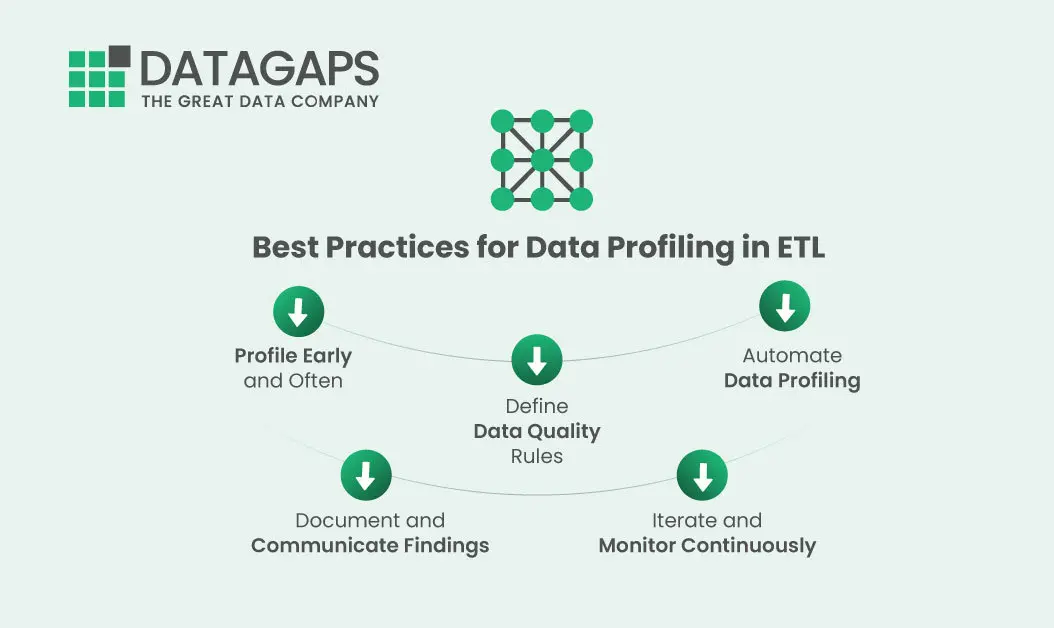
Integrate profiling at multiple stages in the ETL process to identify and correct quality issues at the source, during transformation, and before loading. Profiling early minimizes downstream errors.
2. Define Data Quality Rules
Establish rules that define what constitutes quality data, such as acceptable ranges for numerical data, mandatory field presence, and consistent data types. These rules should guide your profiling and help standardize data across sources.
3. Automate Data Profiling
Datagaps ETL Validator provides automated data profiling as a native capability within the ETL test workflow — generating column statistics, pattern analysis, and relationship detection without separate tooling.
4. Document and Communicate Findings
Profiling generates valuable insights that should be shared with all data stakeholders. Documenting profiling results can inform downstream teams about data health, enhancing data governance.
5. Iterate and Monitor Continuously
As data evolves, continuous profiling and monitoring are essential to maintain data quality. Scheduling regular profiling checks enables proactive detection and resolution of emerging issues.
Datagaps ETL Validator provides automated data profiling as a native capability.
Frequently Asked Questions
1)What is data profiling in ETL and why is it important?
2)What is the difference between data profiling and data validation?
3)Can data profiling be automated in ETL pipelines?
4)How often should data profiling be performed?
5)What are the most common data quality issues uncovered by profiling?

Anshul Agarwal
Director, Marketing, Datagaps
Director of Marketing at Datagaps. Brings hands-on experience across the data industry and data products to how Datagaps positions DataOps and validation.