Datagaps DataOps Suite is an Agentic Data Quality and Reliability Platform that checks, reconciles and tests your data, so every pipeline, report and AI agent runs on data you can prove. Gartner names Datagaps in its Market Guides for DataOps Tools and Data Observability Tools; QuerySurge isn’t listed in either.
Key Takeaways
- This article checks QuerySurge’s 15 statements about Datagaps against product documentation, QuerySurge’s own pages and Gartner research.
- Buyers bring that page into tool evaluations, so each claim deserves a check against evidence anyone can verify.
- Two claims are fully accurate. Four don’t match the product: deployment, target users, CI/CD integration and BI testing.
- QuerySurge offers a larger DevOps API, and the two tools are level on generating tests from mapping documents.
- Datagaps covers more of the path from source data to final report; a proof of concept on your data confirms it.
QuerySurge published a page comparing itself with Datagaps across 15 categories, and buyers sometimes bring it into tool evaluations. We checked each statement against current Datagaps documentation, QuerySurge’s own pages, independent reviews and Gartner research. This article is for data architects, QA leads and data engineering managers shortlisting data validation tools.
Most of the disagreement comes down to coverage: how much of the path from source data to the final report a tool can test. Where QuerySurge is right, we say so first. Where we disagree, we show what Datagaps does and cite the evidence, so you can check every point yourself.
Where Is QuerySurge's Comparison of Datagaps Accurate?
Several of QuerySurge’s statements about Datagaps are accurate. Some credit Datagaps directly, and one points to a QuerySurge strength buyers should weigh:
- Data security: the page notes that the embedded LLM in Datagaps keeps data in the customer’s environment and that Datagaps is SOC 2 Type II certified. Datagaps is also ISO 27001 certified.
- Partner ecosystem: fair by count. Datagaps works with 7 technology partners and 17+ SI partners; QuerySurge lists 100+.
- Ease of use and scope: the page calls the Datagaps interface user-friendly and describes it as a broader, full-lifecycle platform.
- DevOps API: QuerySurge’s API is larger, with 100+ calls by its own count.
How Do QuerySurge's 15 Claims About Datagaps Hold Up?
Of QuerySurge’s 15 statements about Datagaps, 2 are accurate, 8 are partly accurate, 1 is outdated and 4 don’t match the product. We read QuerySurge’s page on 30 October and 2 November 2026 and checked each claim against Datagaps documentation, QuerySurge’s product pages, G2, Gartner Peer Insights and two Gartner Market Guides.
| # | Category | What QuerySurge says | What Datagaps does | Verdict |
|---|---|---|---|---|
| 1 | Primary focus | "Full lifecycle platform — broader scope, less depth" | Broader scope is right: four products in one suite. Depth includes regression packs for ETL and BI, scheduling and bulk baselines. | Partly accurate |
| 2 | Deployment | "On-prem & cloud, fewer hybrid options" | On-premises, cloud and hybrid; containerized installs; engines on Kubernetes (AKS, EKS, GKE), Databricks, EMR and YARN; AWS and Azure Marketplace. | Not accurate |
| 3 | Target users | "Data engineers, analysts" | Built for QA teams too, plus data quality analysts and business users, with no-code test building, test plans and regression packs. | Not accurate |
| 4 | Ease of use | "UI-driven, more manual setup" | AI agents now build tests from mapping documents or code; a drag-and-drop canvas builds multi-source tests. | Outdated |
| 5 | Test automation | "Automation present, less mature DevOps API" | Scheduling, regression packs, bulk test creation, parallel test plans, REST API and CLI. QuerySurge's API is larger. | Partly accurate |
| 6 | AI capabilities | "Embedded LLM, self-healing tests, agentic AI announced 2026" | Capabilities named correctly. The AI predates the 2026 agentic layer; Gartner described it in October 2025. | Partly accurate |
| 7 | CI/CD integration | "Script-based, no dedicated DevOps API" | Built-in Azure DevOps integration (Azure Test Plans, Azure Repos Git) with JUnit results, plus REST API, CLI, Jenkins and GitHub. | Not accurate |
| 8 | Audit & compliance | "SOC 2 Type II, ISO 27001, basic audit trail" | Certifications right. Exportable audit logs, test and quality-score history, data lineage, audit-ready evidence for SOX, HIPAA and GDPR. | Partly accurate |
| 9 | BI testing | "Higher-level BI validation" | Compares each visual's data with source, checks measure logic, tests every filter combination, compares how reports look across releases, load-tests and governs BI content. | Not accurate |
| 10 | Reusable assets | "Limited reusable components" | Reusable test cases, rule sets and templates, bulk baselines, and data quality rules cloned across projects. | Partly accurate |
| 11 | Data connectors | "Informatica certified, smaller catalog" | Informatica certification is right. Both list 200+ sources and targets; Datagaps connects directly to files, databases, NoSQL including MongoDB, cloud storage and APIs. | Partly accurate |
| 12 | Reporting | "Standard reporting" | Customizable dashboards, data quality scorecards with drill-down, PDF and Excel export, row-level exception downloads. | Partly accurate |
| 13 | Data security | "Embedded LLM, data stays local, SOC 2 Type II" | Correct; also ISO 27001. | Accurate |
| 14 | Customers | "100+ primarily mid-market customers" | 100+ is right. Gartner cites customers in financial services, healthcare, education, energy, technology, manufacturing and telco. | Partly accurate |
| 15 | Partner ecosystem | "Smaller, focused ecosystem" | Fair by count: 7 technology and 17+ SI partners. | Accurate |
Is Datagaps AI "Newer and Less Proven," as QuerySurge Says?
Partly right on timing, not on proof. Datagaps announced its agentic layer in 2026, but the AI underneath was already in the product. Gartner’s Market Guide for DataOps Tools (October 2025) describes Datagaps AI agents that generate test cases and rules from ETL mapping documents or code.
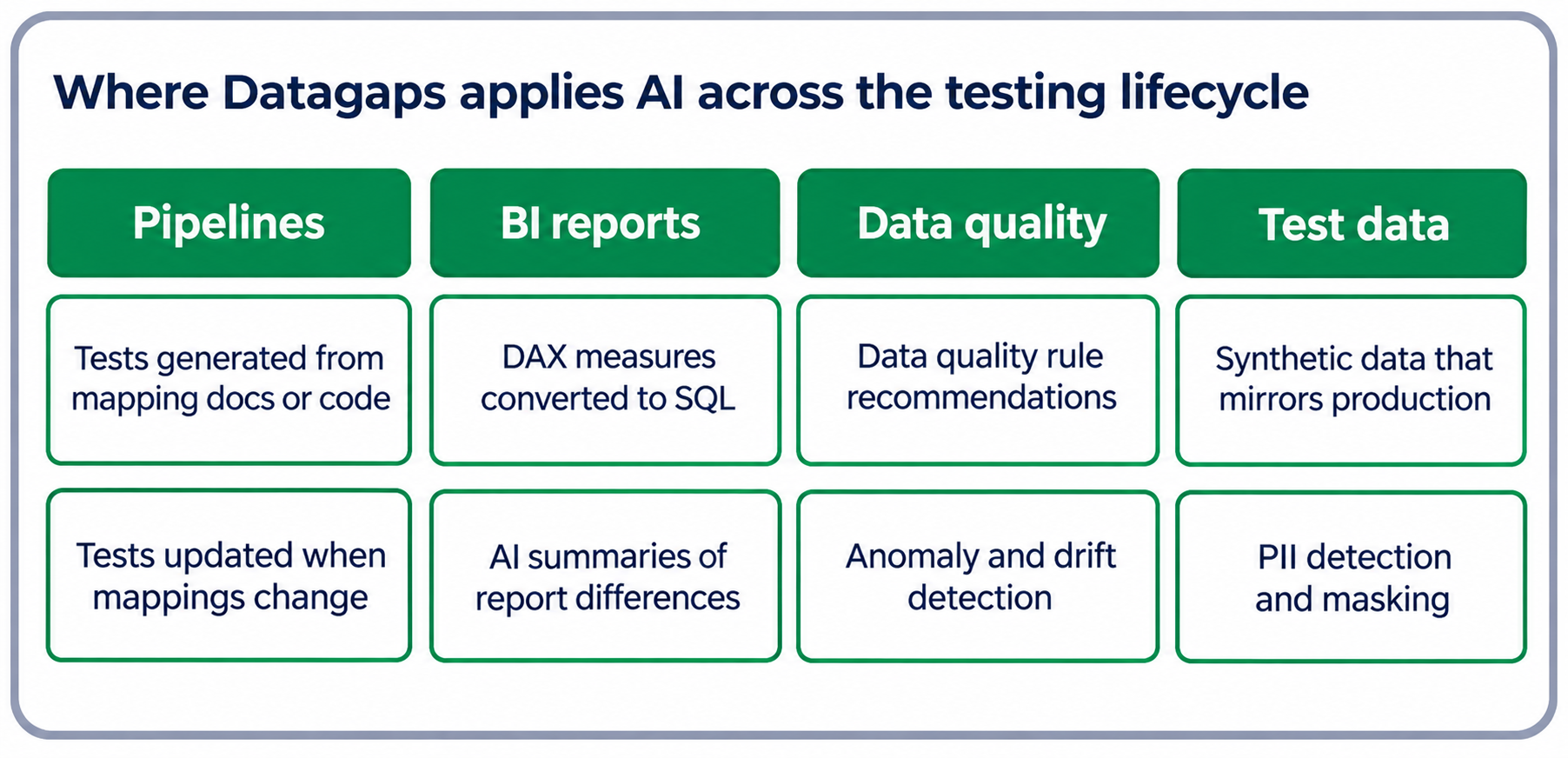
Today that AI works across the testing lifecycle. It builds pipeline tests from mapping documents and updates them when mappings change. It converts Power BI DAX measures into SQL and summarizes report differences. It also recommends data quality rules, detects anomalies and creates synthetic test data with PII masked.
Two controls address the “less proven” concern. A person approves every AI-generated change and every decision is logged. The AI also works on metadata and logic rather than the records themselves, with private deployment options. On one task the tools are level: QuerySurge’s Mapping Intelligence also generates tests from mapping documents. The difference is breadth.
Is CI/CD Integration in Datagaps Script-Based?
No. Datagaps integrates with Azure DevOps out of the box. Teams connect their Azure DevOps organization in DataOps Suite settings, the integration supports Azure Test Plans, and results publish in JUnit format, so tests can gate a release automatically. Datagaps also provides a REST API, a command-line interface, and Jenkins and GitHub integration.
Test assets are version-controlled as well. DataOps Suite connects to Azure Repos as a Git provider, so dataflows, DB flows, pipelines and data models can be committed, pulled and synced. Each container maps to one branch, which keeps development, test and production work separate. Gartner’s Market Guide for DataOps Tools also notes webhook integrations with Jenkins and Azure DevOps.
QuerySurge’s DevOps for Data API is larger, with more than 100 API calls by its own count and integrations with Jenkins, Azure DevOps and GitLab through APIs and webhooks. Teams that build release pipelines around a deep testing API will value that. The disagreement is only with the “script-based” label.
How Does Datagaps BI Validator Compare With QuerySurge BI Tester?
Both tools compare BI report data with source data. QuerySurge’s BI Tester does this for six BI platforms and runs regression tests on report data. Datagaps BI Validator does the same and goes further in four areas that matter when reports change often or serve many users:
- Filter combinations: generates and runs every filter and slicer combination, not one parameter set at a time.
- Visual regression: compares how reports look across releases and environments, with AI-generated summaries of the differences.
- Load testing: simulates concurrent users to measure report response and refresh times.
- BI governance: finds unused measures, duplicate reports and orphaned tables.
Gartner’s Market Guide for DataOps Tools notes BI Validator’s regression and filter-level testing, cross-environment comparison and stress testing. QuerySurge’s public material describes data-level regression without visual comparison, which is why “higher-level BI validation” doesn’t describe the difference.
For Power BI, BI Validator’s DAX-to-SQL agent translates report measures into SQL, so the logic behind a number can be checked directly against the source database rather than only the value it returns.

What Does QuerySurge's Alternatives Whitepaper Leave Out About Datagaps?
Most of the platform. QuerySurge’s whitepaper “Best QuerySurge Alternatives for Data Testing in 2026” includes a section titled “Datagaps DataOps Suite”, but it describes only ETL Validator. It accurately credits Datagaps with Gartner recognition as a specialist, a Spark engine for enterprise data volumes, synthetic test data generation, AI-assisted rule authoring and cross-pipeline orchestration.
The section doesn’t name BI Validator, DataOps Data Quality or Test Data Manager, and lists Jenkins and GitHub as integrations without Azure DevOps. It calls Datagaps “narrower on BI and migration coverage”. On BI, it leaves out the report-to-source checks, filter-combination testing and visual regression covered above. On migration, Datagaps validates moves from legacy and on-premises systems to Snowflake, Databricks, Azure Synapse and Microsoft Fabric, compares both environments while they run in parallel, and checks reports after the move.
The paper also points Datagaps at “senior data engineers”, yet credits its rule authoring for working “without deep SQL expertise”. Datagaps tests can be built visually, in SQL or in Python, so QA, BI and data quality teams can build them as well as engineers.
How Should Buyers Verify a Vendor's Comparison Claims?
Check every vendor comparison, including ours, against sources the vendor doesn’t control. According to Gartner’s Market Guide for DataOps Tools (October 2025), the DataOps tools market grew 21% in 2024 to $424 million, so buyers face more tools and more claims than before. Three questions help:
| Question | How to check it |
|---|---|
| Does it cover your whole data lifecycle, from ingestion through pipelines to BI reports? | Ask for a demo across every layer you need, not only the warehouse. |
| Is it recognized outside its own marketing? | Datagaps is the only data pipeline test automation vendor named in both Gartner's Market Guide for DataOps Tools (Oct 2025) and Market Guide for Data Observability Tools (Feb 2026). Check G2 and Gartner Peer Insights too. |
| Does it work on your data? | Run a proof of concept on your own sources, volumes and reports. |
QuerySurge’s page counts three Gartner categories for itself and two for Datagaps. Those categories are Gartner Peer Insights listings, which the page itself describes as vendor-nominated; Gartner’s Market Guides are analyst research, and Datagaps is named in two while QuerySurge isn’t named in either.
What's the Takeaway for Teams Evaluating Datagaps and QuerySurge?
QuerySurge’s comparison page gets several things right: Datagaps security certifications, broad scope and user-friendly interface, and QuerySurge’s larger DevOps API. It falls short in describing Datagaps as it is today, with hybrid deployment, QA-team workflows, built-in CI/CD, AI across the lifecycle and BI testing that goes beyond report data.
QuerySurge suits SQL-first teams that want a deep testing API inside their release pipelines. Datagaps, an Agentic Data Quality and Reliability Platform, suits teams that need to test from source to report in one place, with data quality monitoring and test data management alongside pipeline and BI testing.
If you’re choosing between the two, run both on your own pipelines and reports before you decide.
For a full side-by-side comparison, read Datagaps vs QuerySurge: A Comparison Guide to Data Validation & Quality.
Run a proof of concept on your own data → | Start a 14-day free trial →
See Datagaps validate a QuerySurge-style workload end-to-end on your data
Our team will run a live demo against your specific use case — your stack, your data problem, your pipeline.
SOC 2 Type II certified | ISO 27001 certified | No credit card required for trial | Your data never leaves your environment
Frequently Asked Questions
Is QuerySurge's comparison of Datagaps accurate?
Partly. Of the 15 statements QuerySurge makes about Datagaps on its comparison page, 2 are accurate, 8 are partly accurate, 1 is outdated and 4 don’t match the product. The four that don’t match cover deployment options, target users, CI/CD integration and BI testing. The claim-by-claim table in this article shows the evidence for each verdict.
Is Datagaps only an ETL testing tool, or does it also test BI reports and data quality?
Datagaps covers all three. DataOps Suite, an Agentic Data Quality and Reliability Platform, includes ETL Validator for pipeline and migration testing, BI Validator for report testing, DataOps Data Quality for data quality scoring and observability, and Test Data Manager for synthetic test data. Each product can be bought on its own, and together they connect to 200+ sources and targets.
Is Datagaps AI proven enough for production data testing?
The AI is part of the shipping product. Gartner’s Market Guide for DataOps Tools (October 2025) describes Datagaps AI agents that generate test cases and rules from mapping documents or code. A person approves every AI-generated change, every decision is logged, and the AI works on metadata and logic rather than the records themselves. The agentic layer announced in 2026 adds to it.
Is Datagaps recognized by Gartner, and is QuerySurge?
Gartner names Datagaps in its Market Guide for DataOps Tools (October 2025) and Market Guide for Data Observability Tools (February 2026), making it the only data pipeline test automation vendor in both. QuerySurge isn’t listed in either guide. Both products appear on Gartner Peer Insights, where review counts for each are still small.
Where can I compare Datagaps and QuerySurge side by side?
Our comparison guide covers both tools across pipeline testing, BI testing, data quality, AI, automation, deployment and licensing. It also shows where QuerySurge fits, such as teams built around its DevOps API and SQL-first workflow, and which kinds of teams each tool suits best.

Raj Mohan Achanta
Associate Product Manager, Datagaps
Associate Product Manager at Datagaps. Shapes the product experience across ETL Validator, BI Validator, and DataOps Data Quality.

Avinash Keshri
Head, Product Marketing
Head of Product Marketing at Datagaps and IIM Bangalore alumnus. 13+ years of experience in commercializing AI and data platforms across global markets.