

What are ETL Testing Tools?
ETL testing tools are purpose-built platforms that validate data as it moves through extract, transform, and load pipelines. As data pipelines become more complex, organizations rely on ETL testing tools to verify transformations, detect data issues, and maintain trust in analytics.
While many teams explore general ETL tools, it is important to distinguish between ETL tools used for data movement and ETL testing tools used for validation and quality assurance.
Looking for a structured starting point? Check out our ETL Testing Checklist
When are ETL Testing Tools Used?
ETL testing tools are primarily used across two major categories of projects where data accuracy is critical:
1. Data Migration Projects
These involve moving data across systems while ensuring consistency and completeness. Common scenarios include:
- Application migrations
- Cloud migrations such as moving to Snowflake or Databricks
- Data warehouse migrations such as Teradata to Redshift or Teradata to Databricks
In these cases, ETL testing tools and data testing tools are essential for validating large-scale data movement and ensuring no data loss or transformation errors.
Need help with data migration? Explore our Data Migration Solution page.
2. Data Pipeline Testing
These focus on ongoing validation of data pipelines in production environments. Key use cases include:
- Verifying data transformations across pipelines
- Ensuring consistency between source and target systems
- Detecting data quality issues early
- Supporting continuous validation as pipelines scale Here, ETL automation testing tools help teams scale validation, reduce manual effort, and maintain data quality across evolving pipelines.
Read more on ETL Testing for data pipeline environments.
Evaluation Criteria: How We Selected and Assessed ETL Testing Tools?
Modern ETL testing tools are expected to deliver multi-source validation, transformation testing, automation, AI-assisted test creation, and scalability across large data environments. These capabilities formed the basis of our evaluation.
Several tools come up frequently in this space. iceDQ, Tosca DI, and Informatica DVO were considered but excluded for specific reasons:
iceDQ: The on-premise version of iceDQ lacks several core ETL testing capabilities that enterprise teams typically require. The SaaS version is more feature-complete but not suited for teams that need on-premise deployment.
Informatica DVO: Informatica DVO is not a standalone ETL testing tool. It runs only within the Informatica platform, making it irrelevant for teams outside that ecosystem.
Tosca DI: While Tosca is a popular choice for application and UI testing, Tosca DI is found to be limited in scope for ETL testing and end-to-end pipeline validation, making it a less suitable option for teams with comprehensive data pipeline testing requirements.
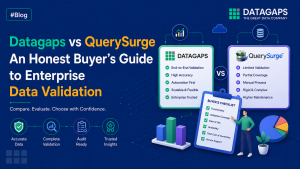
ETL testing tools broadly fall into three categories: purpose-built ETL testing platforms, query-based validation tools, and developer-first testing frameworks. This comparison selects one representative from each category to highlight how different approaches address the same validation challenges. In this comparison, Datagaps ETL Validator represents the purpose-built category, QuerySurge the query-based approach, and dbt Tests the developer-first framework.
Evaluation was based on nine criteria that reflect real production requirements: core ETL testing capabilities, automation and CI/CD integration, usability and test authoring, data quality and observability, data contracts and governance, testing scope and coverage, enterprise readiness, scalability and performance, and pricing and accessibility.
Top 3 ETL Testing Tools: Detailed Comparison
Below is a detailed comparison of three widely considered options: Datagaps ETL Validator, QuerySurge, and dbt tests.
← Scroll to see full table →
| Feature / Capability | Datagaps ETL Validator |
QuerySurge | dbt Tests | Verdict |
|---|---|---|---|---|
| 1. Core ETL Testing | ||||
| ETL Test Authoring & Execution | ✔ | ✔ | ◐ | ETL Validator and QuerySurge are purpose-built for end-to-end ETL test authoring and execution. dbt Tests define quality checks on dbt models only. |
| ELT / In-Database Testing | ✔ | ◐ | ✔ | ETL Validator and dbt Tests push validation to the warehouse natively. ETL Validator leads on orchestration across multiple platforms. QuerySurge is partial. |
| Flat File / CSV Testing | ✔ | ✔ | ✘ | ETL Validator and QuerySurge handle flat file and CSV validation natively. dbt Tests are database-only. |
| Multiple Source / Target Support | ★ | ◐ | ✘ | ETL Validator supports multiple heterogeneous sources and targets in a single test run. QuerySurge supports only a single source-target pair. dbt Tests operate within a single warehouse. |
| Transformation Validation | ★ | ✔ | ✔ | ETL Validator adds GenAI-assisted rule authoring across any ecosystem. dbt Tests are strong for validating dbt model outputs. QuerySurge uses SQL-based validation. |
| Source-to-Target Reconciliation | ✔ | ✔ | ✘ | ETL Validator uniquely supports Data Profile reconciliation. QuerySurge covers row counts and aggregations. dbt has no cross-system reconciliation. |
| Source-to-Report Testing | ✔ | ◐ | ✘ | ETL Validator validates the full chain from raw source through to the BI report layer. QuerySurge has limited support. dbt Tests do not reach the reporting layer. |
| Non-dbt Pipeline Testing | ✔ | ✔ | ✘ | ETL Validator and QuerySurge test any pipeline regardless of transformation tool. dbt Tests are locked to dbt models. |
| 2. Automation & CI/CD | ||||
| Automated Regression Testing | ✔ | ✔ | ◐ | ETL Validator adds GenAI-assisted test maintenance. QuerySurge offers structured ETL regression automation. dbt Tests re-run on every invocation but have no dedicated regression management. |
| CI/CD Pipeline Integration | ✔ | ✔ | ★ | dbt Tests have first-class CI/CD integration. ETL Validator and QuerySurge both support CI/CD with broad pipeline trigger options. |
| Scheduled / Triggered Test Runs | ✔ | ✔ | ◐ | ETL Validator and QuerySurge support native scheduling and REST API triggers. dbt Tests depend on dbt Cloud or an external orchestrator such as Airflow. |
| Test Case Reusability | ✔ | ✔ | ✔ | All three support reusable test definitions. ETL Validator and QuerySurge offer reusable templates via their UIs and test libraries. |
| Test Maintenance Overhead | Low | Medium | Medium-High | ETL Validator's GenAI-assisted maintenance significantly reduces upkeep as pipelines change. dbt Tests require engineers to update definitions manually for every model or schema change. |
| Cross-Pipeline Orchestration | ✔ | ✔ | ✘ | ETL Validator and QuerySurge orchestrate tests across multiple pipelines in a single run. dbt Tests are scoped to the dbt DAG. |
| 3. Usability & Test Authoring | ||||
| No-Code / Visual Test Builder | ★ | ◐ | ✘ | ETL Validator is the only tool with a drag-and-drop no-code interface for ETL testing. QuerySurge is partial. dbt Tests are written entirely in YAML and SQL. |
| Ease of Setup | ✔ | ✔ | ◐ | ETL Validator and QuerySurge deploy in days. dbt Tests require an existing dbt project before writing a single test. |
| Business User Accessibility | ✔ | ◐ | ✘ | ETL Validator is designed for QA analysts and business users without coding skills. QuerySurge requires SQL knowledge. dbt Tests require proficiency in dbt, YAML, SQL, and version control. |
| GenAI / AI-Assisted Test Creation | ★ | ◐ | ✘ | ETL Validator generates tests automatically from ETL mapping documents using agentic AI, cutting initial test creation time by over 60%. QuerySurge offers limited GenAI support. |
| Test Documentation & Visibility | ✔ | ✔ | ◐ | ETL Validator provides customisable stakeholder dashboards. QuerySurge offers detailed reporting. dbt generates docs automatically but test visibility for non-engineers is limited. |
| Learning Curve | Low | Low-Medium | High | ETL Validator is the fastest to productive use for any team profile. dbt Tests require mastery of the full dbt framework. |
| 4. Data Quality & Observability | ||||
| Data Quality Monitoring | ✔ | ◐ | ◐ | ETL Validator provides continuous DQ monitoring with scoring and alerting. dbt Tests and QuerySurge run at job execution time only. |
| Anomaly Detection | ✔ | ✘ | ✘ | ETL Validator automatically detects data anomalies across pipelines using AI. Neither QuerySurge nor dbt Tests offer automated anomaly detection. |
| Data Profiling | ✔ | ◐ | ✘ | ETL Validator provides rich data profiling alongside test execution. QuerySurge offers basic profiling. dbt Tests require separate tools such as dbt-profiler or Elementary. |
| Data Lineage | ✔ | ✘ | ★ | dbt auto-generates column-level lineage across the entire DAG. ETL Validator provides pipeline-level lineage tied to DQ scoring. QuerySurge has no lineage support. |
| DQ Scoring & Health Dashboards | ★ | ✘ | ✘ | ETL Validator uniquely provides quantified DQ scores and health dashboards across pipelines. Neither QuerySurge nor dbt offer this natively. |
| Alerting & Notifications | ✔ | ✔ | ◐ | ETL Validator and QuerySurge support native alerting on test failures. dbt alerting depends on the orchestration layer. |
| BI Regression Testing | ★ | ✘ | ✘ | ETL Validator's visual BI report regression testing across Power BI, Tableau, QuickSight, and Oracle Analytics has no equivalent in QuerySurge or dbt. |
| 5. Data Contracts & Governance | ||||
| Data Contracts | ★ | ✘ | ◐ | ETL Validator supports formal data contracts for validating data and schema obligations across pipeline boundaries. dbt has partial support via dbt contracts. QuerySurge has none. |
| Schema Validation & Drift Detection | ✔ | ◐ | ✔ | ETL Validator and dbt Tests both detect schema drift. QuerySurge offers partial schema validation. |
| Data Observability Integration | ✔ | ◐ | ◐ | ETL Validator provides built-in observability across the full pipeline. dbt integrates with third-party tools. QuerySurge is less observability-focused. |
| Audit Trails & Compliance Reporting | ✔ | ✔ | ✘ | ETL Validator and QuerySurge provide compliance-grade audit trails out of the box. dbt requires significant custom engineering to produce audit-ready reports. |
| Role-Based Access Control | ✔ | ✔ | ◐ | ETL Validator and QuerySurge support enterprise RBAC natively. dbt Cloud offers team-level permissions; dbt Core has no access control layer. |
| 6. Testing Scope & Coverage | ||||
| Mixed-Source Pipelines | ★ | ✔ | ✘ | ETL Validator's Apache Spark engine supports heterogeneous sources including databases, files, and APIs. dbt is warehouse-only. |
| Legacy System Testing | ✔ | ✔ | ✘ | ETL Validator and QuerySurge test pipelines built in any ETL tool including legacy platforms. dbt Tests are not suitable for non-dbt pipelines. |
| Streaming / Real-Time Data Validation | ◐ | ◐ | ✘ | ETL Validator and QuerySurge have partial streaming support. dbt is mainly a batch transformation tool. |
| Extensibility | ★ | ✘ | ✘ | ETL Validator provides the capability to add custom plugins using Python, making it highly extensible. QuerySurge and dbt have a fixed set of capabilities. |
| Test Data Generation | ★ | ✘ | ✘ | ETL Validator uniquely generates synthetic test data for automating pipeline testing, reducing reliance on production data copies. |
| End-to-End Pipeline Coverage | ★ | ◐ | ◐ | ETL Validator covers ingestion, transformation, loading, and BI reporting. dbt Tests cover only the transformation layer within dbt models. |
| 7. Enterprise Readiness | ||||
| Enterprise Support & SLAs | ✔ | ✔ | ◐ | ETL Validator and QuerySurge offer dedicated commercial support with SLAs. dbt Core is open-source with community support only. |
| On-Premise Deployment | ✔ | ✔ | ◐ | ETL Validator and QuerySurge support on-premise deployment. dbt Cloud is SaaS-based. |
| Multi-Project / Multi-Team Support | ★ | ◐ | ◐ | ETL Validator supports multiple projects in a single deployment with container isolation. QuerySurge supports multi-team setups. |
| Custom Dashboards for Stakeholders | ★ | ✔ | ✘ | ETL Validator uniquely provides customisable stakeholder-facing dashboards for sharing test results and data quality scores. |
| 8. Scalability & Performance | ||||
| Handling Large Data Volumes | ✔ | ◐ | ✔ | ETL Validator's Spark-based execution engine is built for billions of records. QuerySurge is comparatively limited for enterprise-scale data volumes. |
| Auto-Scaling | ★ | ◐ | ◐ | ETL Validator has native on-demand auto-scaling. dbt and QuerySurge rely on underlying infrastructure. |
| Parallel Test Execution | ✔ | ✔ | ◐ | ETL Validator's Spark engine enables high-parallelism across hundreds of tests simultaneously. dbt test parallelism is warehouse-dependent. |
| Cloud-Native Deployment | ✔ | ✔ | ✔ | All three are cloud-native. ETL Validator supports AKS, EKS, GKE, and Databricks. dbt Cloud is fully managed. |
| 9. Pricing & Accessibility | ||||
| Licensing Model | Commercial | Commercial | Open-Source / dbt Cloud | dbt Core is free and open-source; dbt Cloud adds a managed commercial tier. The true cost of dbt Tests includes engineering time to build, maintain, and extend. |
| Relative Cost | Best value | Mid-range | Free + engineering cost | dbt Tests appear free, but the hidden cost is engineering hours to configure and maintain them. ETL Validator delivers broad feature coverage across total cost of ownership. |
| ETL Vendor Lock-in Risk | Low | Low | Medium | dbt Tests are tightly coupled to the dbt ecosystem. ETL Validator and QuerySurge carry low lock-in risk. |
| Ideal Team Profile | Data Engineering & QA teams of all sizes | QA Teams | dbt-native analytics engineers | dbt Tests only make sense for teams already running dbt. ETL Validator serves QA, engineering, and business users. |
Which ETL Testing Tool Should You Choose?
Choosing the right ETL testing tool depends on how comprehensive your testing needs are across data pipelines. While multiple tools offer specific capabilities, they differ significantly in scope, flexibility, and coverage.
Datagaps ETL Validator
Datagaps ETL Validator provides a more complete approach by supporting end-to-end ETL testing across heterogeneous data sources, including databases, files, APIs and BI layers. It also offers automation, AI-driven test generation, and scalability required for modern data environments.
QuerySurge
QuerySurge is effective for SQL-based validation but is largely limited to query-pair comparisons and does not support broader multi-system or end-to-end pipeline testing scenarios.
dbt tests
dbt Tests are limited to rule-based data checks within a single data warehouse. They are not built for complete ETL testing and do not address pipeline validation across systems.
Our Recommendation for ETL Testing Tool
For teams that need comprehensive coverage across the full pipeline, Datagaps ETL Validator is the clear choice. Where QuerySurge stops at query-pair validation and does not scale effectively for large data volumes, and dbt Tests stay within the warehouse running rule-based checks, Datagaps ETL Validator goes further: across sources, through transformations, and all the way to the BI reporting layer. Built on a Spark-based engine, Datagaps ETL Validator is designed to scale for enterprise data volumes without compromising on performance. It is purpose-built for ETL testing and Datagaps is recognized as a data pipelines test automation specialist in Gartner’s Market Guide for DataOps Tools. If reliable, end-to-end data validation matters to your team, Datagaps ETL Validator is the tool built for that job.
For teams looking beyond framework-specific validation toward complete pipeline testing and ETL automation, Datagaps ETL Validator offers a more comprehensive approach.
Disclaimer: The above-mentioned list is purely an outcome of the conversations and feedback received from various industry users in the ETL/Data Warehouse testing space. Any concerns or views can be shared at contact@datagaps.com