

Key Takeaways:
- Data/BI testing validates data accuracy, transformation logic, and report integrity at the data level.
- Application testing (Selenium, Tosca) validates UI behavior only — no data awareness.
- Using application testing tools for data validation creates 60-80% coverage gaps.
- Datagaps ETL Validator and BI Validator are purpose-built for data-centric testing needs.
In today’s data-driven landscape, organizations rely heavily on Business Intelligence (BI) systems to inform strategic decisions. According to Gartner, poor data quality costs organizations $12.9 million annually. Generic application testing tools cannot detect these data-level issues. The integrity, accuracy, and performance of these systems are paramount, making the choice of testing tools critical. Specialized data and BI testing tools offer distinct advantages over generic application testing tools, particularly in handling the complexities inherent in data-centric environments.
What Is the Difference Between Data Testing and Application Testing?
Both data testing and application testing are essential for ensuring system functionality, but their focuses and methodologies are distinct:
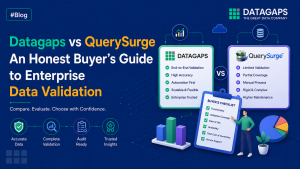
| Application Testing | Data Testing |
|---|---|
| ✔ Focuses on user interfaces, scripting, APIs, and code integrity. | ✔ Prioritizes ETL (Extract, Transform, Load) processes, data integrity, and orchestration of data workflows. |
| ✔ Designed to validate the user experience and performance of application components. | ✔ Often involves validating millions or even billions of records, requiring specialized tools for scale and complexity. |
Challenges in Data and BI Testing
According to Harvard Business Review, bad data costs the U.S. economy $3.1 trillion annually. Data accuracy issues from untested pipelines contribute directly.Data and BI systems present unique challenges that generic application testing tools may not adequately address:

- 1. Data Volume and Complexity
- The Challenge:
BI systems process vast amounts of data from diverse sources.
- Solution:
Specialized tools efficiently handle large-scale data comparisons and integrity checks, ensuring data accuracy.
- 2. ETL Process Validation
- The Challenge:
Validating data extraction, transformation, and loading (ETL) processes is critical.
- Solution:
Specialized tools provide comprehensive testing for ETL processes , identifying discrepancies that generic tools often miss.
- 3. Performance and Scalability
- The Challenge:
BI systems must deliver optimal performance under varying user loads and data volumes.
- Solution:
Specialized testing tools simulate user scenarios and data loads, ensuring reliable performance and scalability.
- 4. Data Quality and Observability
- The Challenge:
Reliable BI insights require high data quality and continuous monitoring.
- Solution:
Advanced tools offer features like data profiling, rules validation, and anomaly detection to maintain data accuracy.
By addressing these challenges, specialized data and BI testing tools empower organizations to ensure robust system functionality and accurate insights.
For example, Selenium can verify that a Power BI dashboard page loads — but it cannot validate whether the numbers match the source database, whether filters return correct subsets, or whether DAX calculations are accurate. BI Validator does all of this automatically across Power BI, Tableau, and Oracle Analytics. Datagaps is listed in the Gartner Market Guide for DataOps Tools.
What Are the Advantages of Specialized Data and BI Testing Tools?
Specialized testing tools are tailored to address the specific needs of data and BI environments, offering several key advantages:
| Feature | Benefit | Comparison to Generic Tools |
|---|---|---|
| Performance & Scalability | Uses powerful engines like Apache Spark to handle large datasets efficiently. | Generic tools often rely on less scalable architectures, leading to performance bottlenecks. |
| Comprehensive Data Source Support | Native connectivity to various data sources, including file types, JDBC, and NoSQL databases. | Limited connectivity options may restrict the scope of testing |
| Advanced Transformation Testing | Offers multiple options (e.g., SQL, Python) for data transformation validation. | Generic tools may lack flexibility or advanced transformation testing capabilities. |
| Data Observability & Quality Monitoring | Features like AI-driven anomaly detection and automatic data quality scoring ensure high standards. | Generic tools often lack robust observability and automated quality monitoring. |
| BI Report Testing | Automates regression testing of BI reports to ensure accuracy of visualizations and dashboards. | Generic tools are not designed for BI-specific report validation, increasing manual effort. |
| Stress Testing | Simulates concurrent user access to predict system behavior under heavy load. | Generic tools may not support stress testing tailored to BI reporting environments. |
| Test Data Generation | Leverages AI to generate synthetic data for testing, enhancing coverage without compromising privacy. | Generic tools may lack advanced synthetic data generation features. |
Frequently Asked Questions
1)Why can’t Selenium or Tosca handle data testing?
2)What is the difference between data testing and application testing?
3)Can I use both data testing and application testing tools together?
4)What does Datagaps test that application testing tools cannot?
5)When should an organization invest in dedicated data testing tools?

Anand Rao Vala
VP Marketing, Datagaps
VP of Marketing at Datagaps. Go-to-market leader for enterprise data and analytics, with prior roles at Qlik, Informatica, IBM, and Hitachi Vantara.