

Key Takeaways:
- Regulatory compliance in ETL requires provable accuracy, end-to-end traceability, and audit-ready evidence.
- SOX, HIPAA, and GDPR each mandate different levels of data validation and documentation.
- Embedding validation into CI/CD pipelines ensures compliance is continuous, not reactive.
- Datagaps DataOps Suite operationalizes these capabilities as a unified compliance-ready platform.
Regulatory compliance failures rarely start in audit rooms or BI dashboards. According to Harvard Business Review, bad data costs the U.S. economy $3.1 trillion annually. For regulated industries, compliance penalties add further multiples to this cost. They start much earlier deep inside data pipelines, where quality issues silently accumulate long before reports are generated or controls are reviewed.
With Organizations operating across fragmented data ecosystems such as legacy databases, cloud platforms, modern analytics stacks, they process millions of records through complex ETL pipelines.
While governance frameworks and reporting controls may be well defined, compliance still breaks down when data quality is inconsistent, untraceable, or unverifiable.
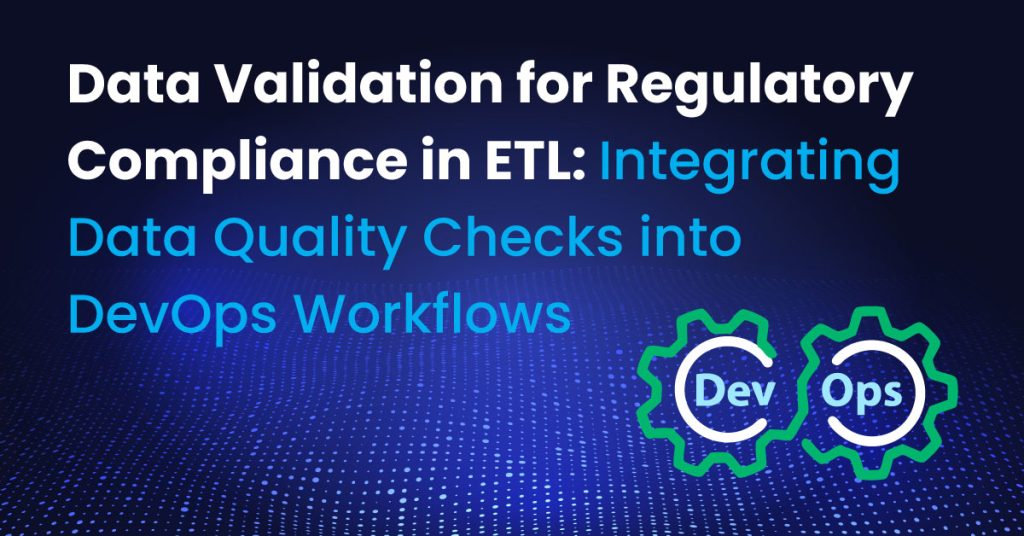
This is why data validation for regulatory compliance in ETL must be understood as a data quality problem first and why modern ETL and DevOps workflows must embed data validation as a foundational control.
Why Is Regulatory Compliance Fundamentally a Data Quality Challenge?
Regulations such as SOX, NAIC Model Audit Rule (MAR), BCBS 239, and similar frameworks do not simply ask for correct numbers. They require provable correctness.
Auditors expect organizations to demonstrate that reported figures are:
- Accurate and complete
- Consistent across systems
- Traceable from reports back to source transactions
- Reproducible with documented, repeatable controls
In practice, these expectations align closely with fundamental data‑quality dimensions. When any of them fail due to reasons like schema drift, inconsistent mappings, partial data loads, or delayed error detection, compliance risk rises immediately, even if the resulting reports appear accurate at first glance.
Why Are Dashboard-Level Checks Insufficient for Compliance?
Many compliance teams continue to depend heavily on dashboard checks and post‑report reviews to verify regulatory metrics. These validations are useful, but they are inherently reactive and occur too late in the data pipeline to prevent issues.
Typical limitations include:
- Variances detected only at high or aggregate levels
- Manual investigation required to trace discrepancies back to their source
- Business logic replicated inconsistently across dashboards and reports
- Limited transparency into how validation rules were applied or changed over time
In short, dashboard‑level validation can tell you that something is wrong, but it rarely explains why it happened or where in the pipeline it originated.
Which Data Quality Checks Actually Matter for Compliance?
Effective compliance-oriented data validation focuses on:
1. Schema and Structural Consistency
Detecting schema drift and unexpected structural changes before they impact downstream logic.
2. Source-to-Target Reconciliation
Ensuring financial totals, counts, and balances match across systems—at both aggregate and transaction levels.
3. Precision and Tolerance Validation
Validating decimal precision, rounding rules, and acceptable variance thresholds critical for financial reporting.
4. Completeness and Referential Integrity
Confirming that all expected records and relationships are present across datasets.
5. Historical and Trend-Based Anomaly Detection
Identifying unusual shifts that may not violate hard rules but indicate emerging compliance risks.
These checks move data quality from a generic hygiene exercise to a regulatory control mechanism.
| Requirement | SOX / ICFR | HIPAA | GDPR |
|---|---|---|---|
| Data accuracy proof | Mandatory for financial data | Required for PHI | Required for PII |
| Audit trail | Full traceability required | Access logs mandatory | Processing records required |
| Data lineage | End-to-end for financial reporting | Source-to-destination for PHI | Required for data subject rights |
| Breach notification | Material weakness disclosure | 60-day notification | 72-hour notification |
| Datagaps capability | Automated validation + audit logs | DQ scoring + access control | Lineage + reconciliation |
According to Gartner, organizations must take “pragmatic and targeted actions to improve enterprise data quality” to accelerate digital transformation.
Why Should Compliance Controls Be Enforced in ETL Pipelines?
ETL pipelines are where data undergoes its most significant changes:
- Business rules are applied
- Aggregations are created
- Mappings evolve
- Legacy and modern systems converge
This makes ETL the most effective layer to enforce data quality for compliance.
By embedding validation directly into ETL workflows:
- Errors are detected before data reaches reports
- Root causes are identified closer to the source
- Compliance issues are prevented, not just observed
In this context, ETL pipelines are not just data movement mechanisms. They become control enforcement layers.
How Do You Integrate Data Quality Validation into DevOps Workflows?
Modern data teams increasingly operate using DevOps principles: CI/CD pipelines, version control, automated testing, and continuous deployment. However, without embedded data validation, DevOps velocity can amplify compliance risk.
Integrating data quality into DevOps workflows enables:
Shift-Left Validation
Running compliance-relevant checks early in the pipeline lifecycle during development and deployment not just during audits.
Controls-as-Code
Defining validation rules as version-controlled assets that evolve alongside ETL logic, ensuring consistency and transparency.
Centralized Audit Evidence
Automatically capturing test definitions, execution results, and approvals in a defensible, audit-ready repository.
Continuous Monitoring
Detecting anomalies and deviations between audit cycles, rather than scrambling during audits.
This approach aligns compliance with how modern data platforms actually operate continuously, not episodically.
How Do You Move From Reactive Compliance to Continuous Assurance?
As discussed earlier, regulatory requirements depend on provable data quality: accuracy, completeness, consistency, and traceability.
These qualities cannot be retroactively imposed at reporting time. They must be enforced where data changes i.e., inside ETL pipelines and governed through repeatable, automated workflows.
This is where continuous data assurance becomes essential.
Instead of treating compliance as a periodic checkpoint, a continuous assurance model:
- Embeds data quality and reconciliation checks directly into ETL workflows
- Executes validations automatically with every pipeline run
- Provides ongoing visibility into data health and control effectiveness
- Reduces audit pressure by maintaining always-available, audit-ready evidence
Datagaps DataOps Suite operationalizes continuous data assurance — embedding automated validation, reconciliation, and audit-ready evidence generation directly into ETL and DevOps workflows.
How Can Organizations Build Scalable, Defensible Compliance Controls?
Regulatory compliance does not fail because teams lack dashboards or policies. It fails when data cannot be trusted, explained, or reproduced under scrutiny.
By recognizing compliance as a data quality problem firstand embedding validation directly into ETL pipelines and DevOps workflows organizations can:
- Prevent compliance issues before they surface
- Reduce manual reconciliation and audit effort
- Build scalable, defensible regulatory controls
In a world of accelerating data change, compliance can no longer be a downstream checkpoint. It must be a continuous, automated assurance process rooted in data quality, enforced through ETL, and operationalized through DevOps.
Leading enterprises have already transformed compliance by embedding data quality and reconciliation directly into their data pipelines.
Explore these real-world case studies to see how upstream data validation enables continuous regulatory compliance
Datagaps DataOps Suite is listed in both Gartner Market Guides for DataOps and Data Observability.
Read the Compliance Case Studies
Frequently Asked Questions
1)Why is data validation critical for regulatory compliance?
2)What compliance risks does ETL testing address?
3)How do you maintain audit trails for ETL pipelines?
4)Can ETL validation support both SOX and HIPAA compliance simultaneously?
5)How does DevOps integration improve compliance testing?

RajMohan Achanta
Associate Product Manager, Datagaps
Associate Product Manager at Datagaps. Shapes the product experience across ETL Validator, BI Validator, and Data Quality Monitor.

Anand Rao Vala
VP Marketing, Datagaps
VP of Marketing at Datagaps. Go-to-market leader for enterprise data and analytics, with prior roles at Qlik, Informatica, IBM, and Hitachi Vantara.