

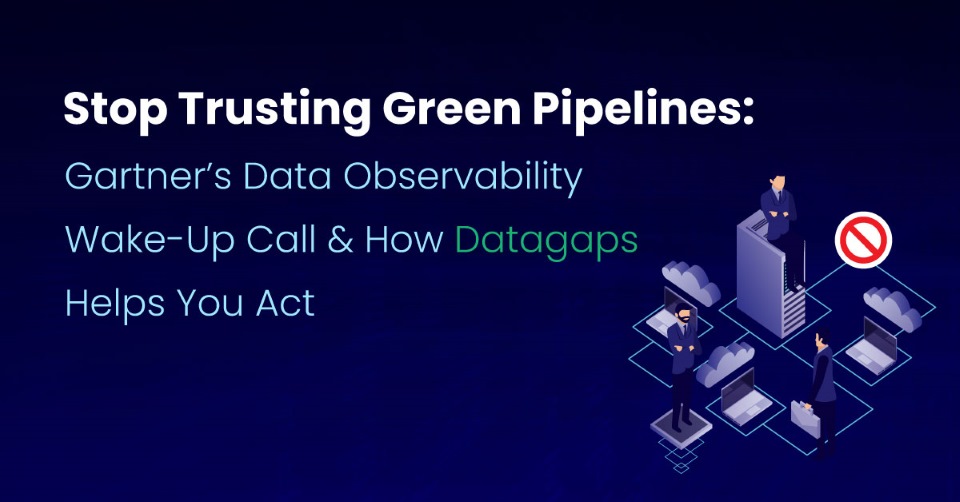
If you’ve ever had a pipeline “succeed” while the business dashboard quietly drifted into nonsense, you already know the uncomfortable truth: job status isn’t data trust.
If you want a solid overview of the data observability category and what buyers look for, the best Gartner® report - Market Guide for Data Observability Tools is a useful place to start.
Our perspective: observability is “data health”, not just monitoring
We think data observability should do five jobs well: continuously watch data workflows, detect issues early, alert the right people, help teams troubleshoot quickly, and support day-to-day operations with context (lineage, collaboration, incident workflows, and cost visibility). Our takeaway is simple: if data drives decisions, then data reliability has to be engineered like uptime.
The five lenses you need to see reliability end-to-end
1. Data content – Is the data accurate, complete, consistent, and within expected bounds?
2. Data flow & pipeline – Is data moving correctly through ingestion, transformation, orchestration, and delivery?
3. Infrastructure & compute – Are resources sufficient, stable, and performant?
4. User usage & utilization – Who is using data, how, and what changed?
5. Financial allocation – What is this pipeline/data product costing, and who owns that spend?
This is the shift teams are making: from “Is the job green?” to “Is the data healthy, used, and worth what it costs?”
We see two big directions shaping buying decisions:
AI augmentation
Expect tools to become better at dynamic thresholds, anomaly prediction, faster root-cause analysis, and even automated remediation actions. In plain terms: fewer false alarms, earlier detection, and less time spent guessing.
Unified platforms
Organizations are increasingly looking for consolidated experiences that reduce tool sprawl. Instead of stitching together monitoring, governance, and security across multiple products, the market is moving toward more unified “single pane” operations.
For buyers, this means your “observability strategy” shouldn’t be another standalone tool – it should be part of how you run DataOps.
How Datagaps aligns with Gartner’s observability roadmap
Datagaps is built for the outcomes Gartner emphasizes – trusted data across the lifecycle, operationalized with repeatability and evidence.
1) Validate data where it lives (not where it’s convenient)
Datagaps focuses on verifying data in place - at the stages that matter most: source-to-target reconciliation, transformation validation, completeness/uniqueness checks, drift detection, and regression testing. This directly supports the “data content” and “data flow” imperatives.
2) Turn detection into action with operational evidence
Datagaps supports repeatable runs, run histories, and evidence-backed outputs so teams can move from “something’s wrong” to “this dataset failed these checks after this change”.
3) Extend trust into BI dashboards (where business trust actually lives)
Datagaps’ BI validation capability helps complete the loop by testing dashboards for regressions, filter inconsistencies, and metric discrepancies. This bridges a common observability gap where pipelines may be healthy while the analytics layer is not.
4) Scale coverage with AI-assisted rule creation
Datagaps aligns with the move toward AI through profiling and anomaly detection approaches, plus AI/metadata-assisted rule generation that helps teams scale validation without scaling manual effort linearly.
How to use the report: A simple pilot blueprint that works
- Pick one high-impact data product (revenue dashboard, regulatory pipeline, AI feature dataset).
- Define trust signals (freshness, reconciliation, drift thresholds, KPI integrity).
- Implement validations across ingestion → transformations → consumption (including BI).
- Operationalize outcomes (ownership, alerts, run history, incident workflow).
- Measure business results: fewer incidents, faster root cause analysis, and fewer post-release surprises.
Ready to make data trust measurable?
Download the Gartner Market Guide and learn more.
Request a pilot plan and we’ll help you identify the highest-impact gap to prove ROI fast.
Source: Gartner Report, Market Guide for Data Observability Tools, By Melody Chien and Michael Simone, February 2026.
Talk to a Datagaps Expert
Find out how Datagaps can help your team deliver better data products, faster.