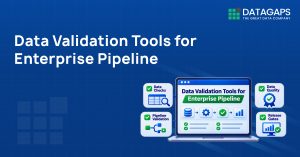
Data validation tools check that data is complete, accurate, consistent, and valid as it moves through a pipeline. For enterprise pipelines, they compare source and target records, test transformation rules, and run recurring quality checks, then keep evidence of each result. The right choice depends on how many systems, teams, and audits the pipeline touches.
Feature lists hide the questions that matter later: what gets validated, who owns the checks, and what evidence remains after a run. This guide helps teams choose data validation testing tools by approach first, criteria second, and proof last.
Key Takeaways
- Choose the approach before the tool: spreadsheets and ad hoc SQL for one-off checks, code-first frameworks for engineer-owned pipelines, and a managed platform for cross-engine, team-wide validation with audit evidence.
- Evaluate connectivity, test creation, evidence, and deployment, then prove the shortlist on your own data with seeded defects, expected results, and a scorecard.
- Datagaps ETL Validator, part of DataOps Suite, can connect to 200+ data sources and keeps audit logs and exportable results as evidence.
Datagaps DataOps Suite, is a data quality platform that validates, reconciles, scores, and monitors data from ingestion to BI and AI. It includes ETL Validator for ETL, ELT, and migration testing, DataOps Data Quality for continuous scoring, and BI Validator for reports. The examples use these products; the criteria apply to any tool.
What Should Data Validation Tools Validate in a Data Pipeline?
They should validate four things: structure (schemas and types), completeness (every record arrived), transformation logic (business rules produced the right values), and ongoing quality (rules and trends that hold on every load). Figure 1 shows where each runs.
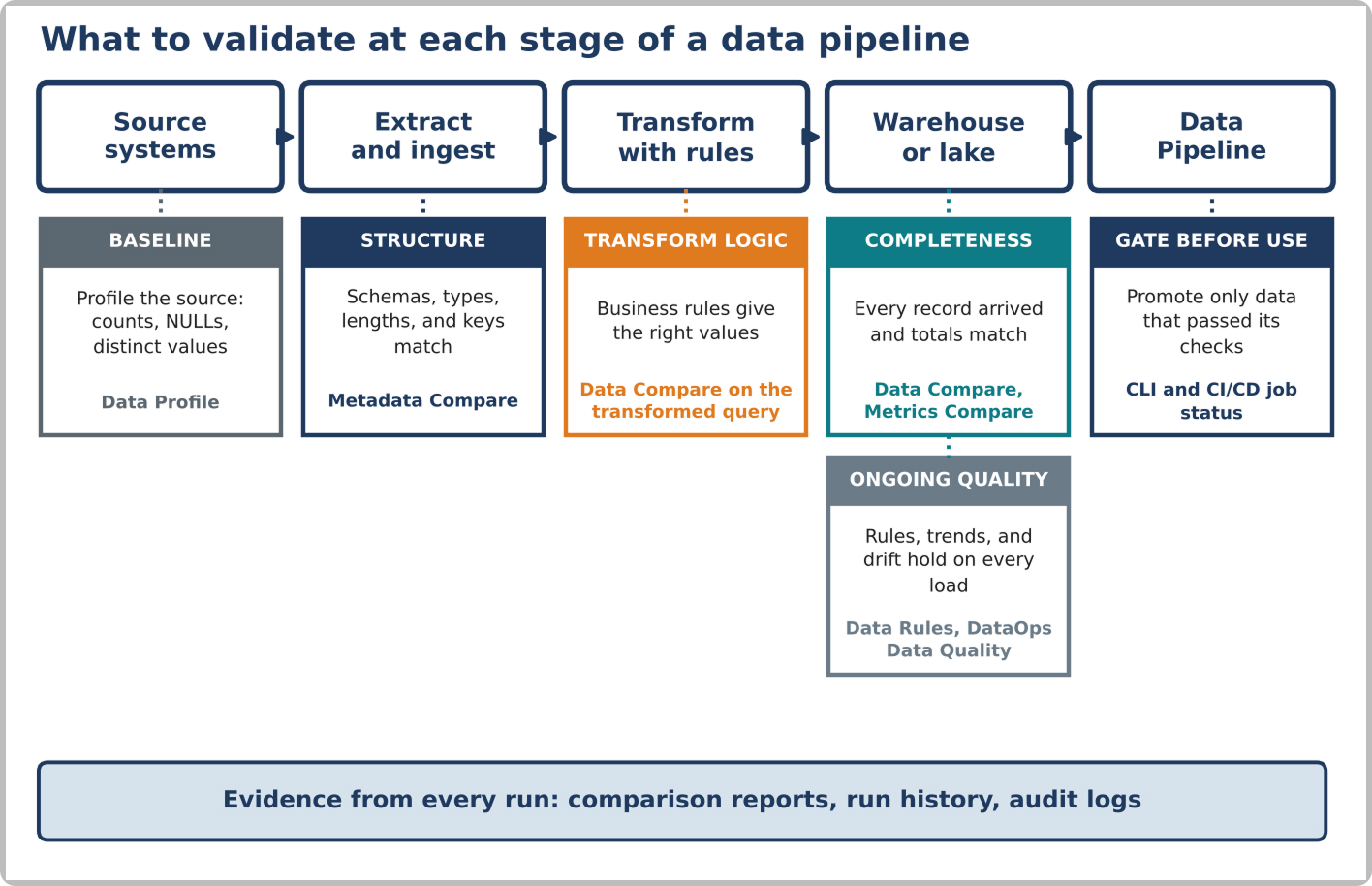
Timing matters as much as category. Validate after extraction, around each transformation, after load, and before data enters the layer that BI and AI consume. In a medallion layout, gate promotion into gold; Datagaps covers Delta Lake tables from Bronze to Gold on Databricks. Validation is data-centric and continuous, while ETL testing checks pipeline logic when it changes, so enterprises need both. Schema drift can also cause silent errors, which Metadata Compare and the catalog’s schema drift view catch.
Missing the rest is costly. Gartner puts the average annual cost of poor data quality at $12.9 million per organization, based on a 2020 survey of reference customers who estimated their own costs (Gartner, July 2024). In a 2023 Wakefield Research survey for Monte Carlo, 74% of data professionals said business stakeholders find data quality issues first all or most of the time.
How Do Spreadsheet, Application, and Enterprise Pipeline Validation Tools Differ?
They differ in the unit of work: a spreadsheet tool checks cells and formulas, an application tool checks screens and APIs, and an enterprise pipeline tool checks records moving between systems at volume.
Mixing them yields mismatched shortlists: a spreadsheet add-in cannot reconcile a large load, and a UI test suite cannot compare a warehouse table with its source. Datagaps compares specialized data and BI testing tools with generic application testing solutions in more detail.
Which Data Validation Tools Fit Which Pipeline Use Case?
Match the validation category to the business use case first, then compare tools.
Reconciliation, Transformation Rules, and Continuous Quality Checks
- Reconciliation proves records match between source and target, as migrations and integrations need. See data reconciliation and data migration testing automation.
- Transformation rules confirm that business logic produced the expected values on every release. ETL Validator verifies business logic with SQL, Python, or Scala.
- Continuous quality checks run rules and trends on a schedule to catch drift between releases. See how to perform continuous data validation and the data quality testing
Every pipeline needs a core set of checks: row counts alongside null rates, range and format rules, duplicate and referential integrity checks, and aggregate comparisons within a tolerance set by risk. In ETL Validator these map to Data Profile and Metrics Compare (aggregates, with thresholds), Data Rules (Domain, Attribute, Duplicate Check, and SQL Query), and Data Compare on a unique key.
What Should You Evaluate in Data Validation Tools: Connectivity, Test Creation, Evidence, and Deployment?
Evaluate four things beyond the feature list: connectivity (can it reach every source and target you run), test creation (how tests get built and kept current), evidence retention (what record remains after a run), and deployment (where it runs and how it gates releases).
Datagaps DataOps Suite is the platform behind the examples below. Its ETL Validator module compares source and target data across databases, files, and cloud platforms, checks transformation logic, and schedules runs, with roles, audit logs, and single sign-on around it.
- Connectivity: ask for the exact connectors, not a count. Datagaps lists 200+ data sources for ETL Validator, covering JDBC databases, files, APIs, and cloud warehouses.
- Test creation: mapping documents define what each transformation should do, so ask whether tests can be built from them. The Generate Dataflow wizard and Mapping Manager draft comparison queries from mapping spreadsheets with AI, and a reviewer approves them.
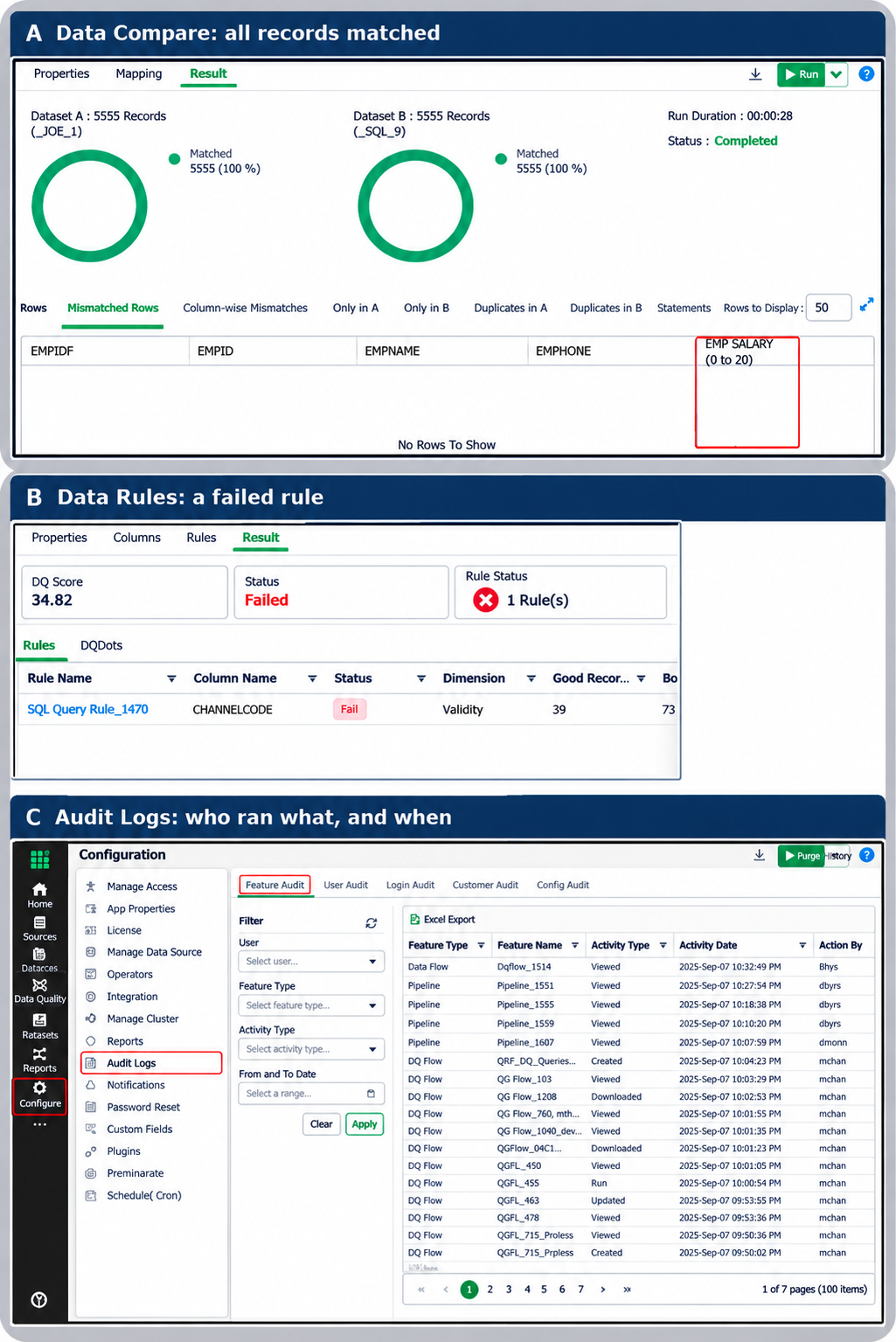
- Evidence retention: ask what survives a run. In DataOps Suite, audit logs record the user, feature, activity, and timestamp, with filters and export, and Data Compare can produce a downloadable comparison report.
- Deployment and security: DataOps Suite runs Spark engines on Kubernetes or Azure Databricks, supports Okta and Azure AD single sign-on, and keeps credentials in an internal or external vault such as Azure Key Vault or CyberArk. A command line and REST API support CI/CD, and a pipeline run’s job status can act as a release gate.
Figure 2 shows evidence to ask any vendor to demonstrate: a passing comparison, a failed rule, and an audit trail.
Evidence supports an audit but does not guarantee compliance. The Basel Committee’s BCBS 239 principles ask banks for accurate, reliable risk data and favor largely automated aggregation (BIS, 2013). See the Datagaps post on ETL data validation for regulatory compliance and the compliance solutions page.
Code-First or Managed: Which Data Validation Tools Fit Your Team?
Code-first tools fit engineer-owned pipelines that already live in version control. Managed platforms fit cross-engine validation, shared ownership between QA and engineering, and audit evidence. The below table compares the five approaches.
| Approach | Best for | Watch for | Evidence trail |
|---|---|---|---|
| Spreadsheets and ad hoc SQL | One-off checks on a few tables | Scripts drift, and scheduling, drivers, and reports need extra code | Whatever the author saves |
| Code-first frameworks (dbt tests, Great Expectations, Deequ) | Engineer-owned pipelines with tests in version control | Coverage depends on engineers writing tests; comparing a source with a target across engines usually needs custom work | Failing records (dbt); Validation Results and Data Docs (Great Expectations) |
| Migration-service validation (for example, AWS DMS) | Tables the service migrates | Scoped to that service; AWS documents limits such as a primary key or unique index requirement | Service metrics and a failures table |
| Managed validation platforms (for example, Datagaps DataOps Suite) | Cross-engine reconciliation, transformation checks, QA-owned tests, scheduled runs, audit evidence | Needs connections, mappings, and unique keys set up; AI-drafted tests need review | Comparison reports, run history, audit logs |
| Data observability tools | Spotting unknown freshness, volume, and schema issues between releases | Flags anomalies but does not prove a transformation rule is correct | Alerts and anomaly history |
Hybrids work. dbt ships four built-in generic data tests that run as SQL queries. DataOps Suite triggers dbt jobs through REST APIs and plugins and compares the results, so engineers keep their tests and QA keeps cross-system comparison. Ad hoc scripts are the weak point, as the Datagaps post on Python scripts versus ETL Validator explains.
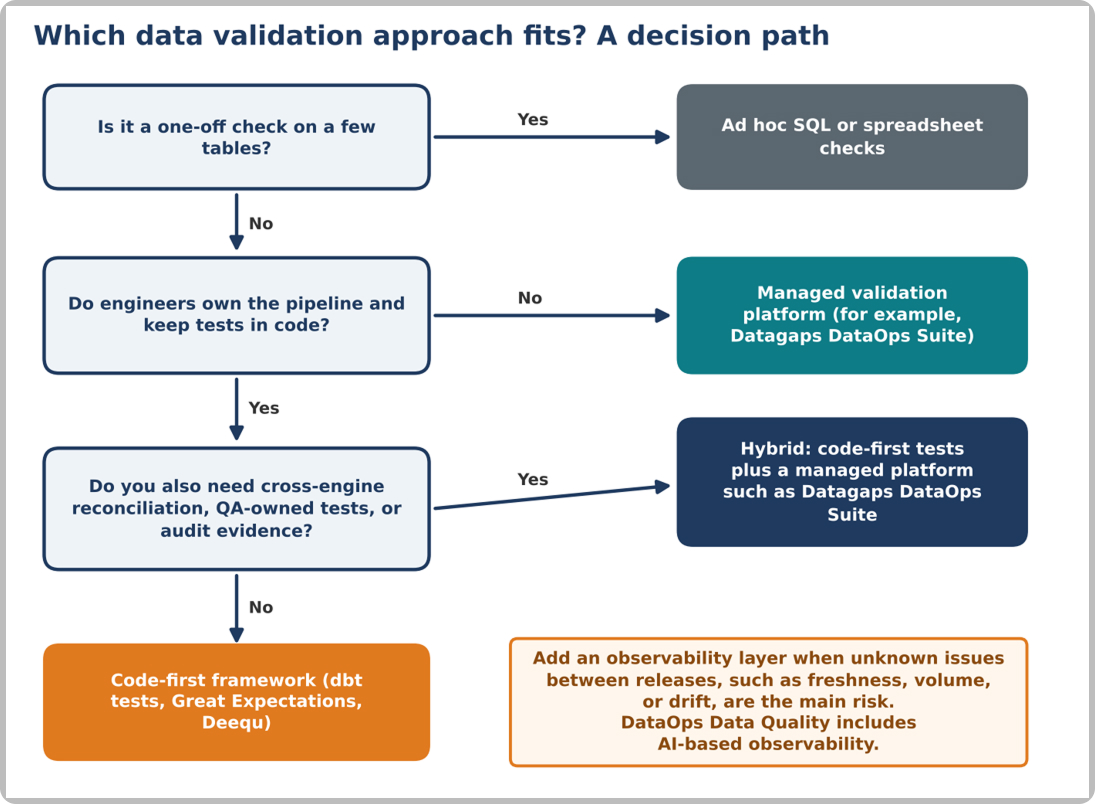
How Do You Validate a Shortlist of Data Validation Tools With a Reproducible POC?
Run the same proof of concept on every shortlisted tool, with the same data, the same expected results, and a written scorecard.
- Pick three representative pipelines, prioritized by downstream use, business-rule complexity, and number of stakeholders: a batch load, a transformation-heavy flow, and a cross-engine comparison.
- Seed known defects into a copy of the data: a missing row, a duplicate key, a truncated value, a rounded amount, and a blank turned NULL.
- Write the expected result for each defect before the run, with tolerances set by risk, so every tool is scored against the same answers.
- Record setup time, defects caught, false alarms, runtime at production volume, and the evidence each tool keeps.
- Score each criterion from 0 to 2 and weight the scores by your audit and volume needs.
In ETL Validator, one POC covers all five defects. Data Compare on a unique key catches the missing and duplicate rows, Metadata Compare catches the narrower column that truncates values, Data Compare with a threshold flags the rounded amount, and Data Rules catch the blank that became NULL.
For vendor comparisons, see Datagaps vs QuerySurge, Datagaps vs iCEDQ, and Top 3 ETL Testing Tools. See also must-haves in a data testing platform for scorecard criteria.
Conclusion: How Do You Choose Data Validation Tools You Can Defend?
Choosing data validation tools for enterprise pipelines comes down to three decisions. Match the approach to the work: ad hoc SQL for one-off checks, code-first frameworks for engineer-owned pipelines, and a managed platform when validation spans engines, teams, and audits. Judge tools on connectivity, test creation, evidence, and deployment, not feature counts. Then prove the shortlist on your own data, with seeded defects, expected results, and a scorecard.
Validation also has to run where the risk is: at each stage of the pipeline and before data reaches BI and AI. When it does not, stakeholders tend to find the problems first. A tool that leaves evidence of every run gives your team an answer when questions arrive.
ETL Validator, part of Datagaps DataOps Suite, can connect to 200+ data sources and keeps comparison reports and audit logs as evidence. Use the POC steps above to test it against any alternative on your own pipelines.
Frequently Asked Questions
What Are Data Validation Tools?
Data validation tools, also called data validation software, test whether data is complete, accurate, consistent, and valid as it moves between systems. They compare source and target records, check transformation rules, run recurring quality checks, and keep results as evidence.
What Is the Difference Between Data Validation Tools and Data Quality Tools?
Data validation tools test data against expected results as it moves, through source-to-target comparisons and transformation checks. Data quality tools monitor tables continuously with rules, scores, and issue tracking. In DataOps Suite, ETL Validator covers the first and DataOps Data Quality covers the second.
What Is the Difference Between Data Validation and ETL Testing?
ETL testing verifies pipeline logic when code or mappings change. Data validation checks the data itself at each stage, on every load. Enterprise pipelines need both.
Can a Data Validation Tool Make Us Compliant?
No. A tool produces evidence that checks ran and what they found. Compliance depends on your controls, and the control owner decides what an auditor needs. Ask vendors to show audit logs, run history, and exportable results.
Are Open-source Data Validation Tools Enough for Enterprise Pipelines?
They can be for engineer-owned pipelines where tests live in code. Enterprises often add a managed platform for cross-engine reconciliation, QA-owned tests, scheduling, and evidence.
Book a personalized 30-minute demo, or start a 14-day free trial.

RajMohan Achanta
Senior Associate Product Manager, Datagaps
Senior Associate Product Manager at Datagaps. Shapes the product experience across ETL Validator, BI Validator, and DataOps Data Quality.

Avinash Keshri
Head, Product Marketing
Head of Product Marketing at Datagaps and IIM Bangalore alumnus. 13+ years of experience in commercializing AI and data platforms across global markets.