


Data integrity is the completeness, consistency, and accuracy of data across its lifecycle. Data integrity challenges arise when migrations, integrations, pipelines, and people change data in ways the source never intended. Testing for them means comparing data across stages and checking the rules that keys, relationships, and values must obey.
Key Takeaways
- Data integrity challenges come from change and movement: schema changes, retried loads, transformation logic, load order, and late data all alter data in ways the source never intended.
- Most integrity failures pass silently because the pipeline job succeeds. Controls have to look at the data, not just the job status.
- Treat integrity as three layers: prevent defects, detect them automatically, and respond with an owner and evidence.
- Match each challenge to a specific check, and run those checks on every load so a defect fails the run that introduced it.
What Are Common Data Integrity Issues, and How Do You Keep Them in Control?
Data integrity issues are cases where data in a target no longer matches what the source and the business rules say it should be. They tend to fall into a few families:
- Missing or duplicated records after retries, partial loads, or overlapping batches.
- Values that change in flight: truncated text, rounded amounts, shifted time zones, and implicit casts.
- Broken relationships: child records with no parent, and keys that no longer match across systems.
- Structural changes: columns added, renamed, or retyped at the source without notice.
- Stale or late data that misses the load window and leaves reports out of date.
- Rules lost in translation: constraints, defaults, and business logic that the target does not enforce.
Left alone, these reach dashboards, models, and regulatory reports, where they are expensive to trace. Three habits keep them under control: define the rules that keys, relationships, and values must obey; compare data between source and target at each stage; and automate those checks so they run on every load, with every failure assigned to an owner. The rest of this post shows how. If the challenge is a platform move, see data integrity testing during data migration, which covers the three-phase migration test plan.
Why Do Data Integrity Problems Happen in Pipelines?
Because pipelines change and move data constantly, and a job can finish successfully while the data is wrong. Orchestrators report whether a job ran, not whether the data is right, so integrity defects pass unnoticed until someone downstream questions a number. Four forces cause most problems:
- Change: source teams add, rename, or retype columns, and mappings drift from the systems they describe.
- Movement: retries, overlapping batches, and partial loads duplicate or drop rows.
- Transformation: business rules, casts, and rounding produce values nobody intended.
- Dependencies: child records load before parents, and late events miss the load window.
Integrations between applications add more seams, as the Datagaps page on application integration testing describes. Figure 1 shows why the point of detection matters.

Which Data Integrity Challenges Hit Pipelines Most, and How Do You Test for Each?
The table below maps six common challenges to their causes, how to prevent and detect each, and the usual fix, with the Datagaps component named for each check.
| Challenge | Why it happens | How to prevent and detect it | Typical fix |
|---|---|---|---|
| Schema drift | A source team adds, renames, or retypes a column without notice | Version mappings and agree change notices. Detect with the catalog’s Schema Drift view, Impact Analysis, and Metadata Compare | Update mappings and queries, then rerun regression tests |
| Duplicate loads | Retries and overlapping batches insert rows again | Make loads repeatable on a business key. Detect with Check Uniqueness in Data Compare or the Duplicate Check rule | Deduplicate on the key and fix the retry logic |
| Late-arriving data | Events or dimension rows arrive after the load window | Use reprocessing windows. Detect with Metrics Compare on counts and totals for each window, and observability for freshness | Reprocess the window and add a late-arrival rule |
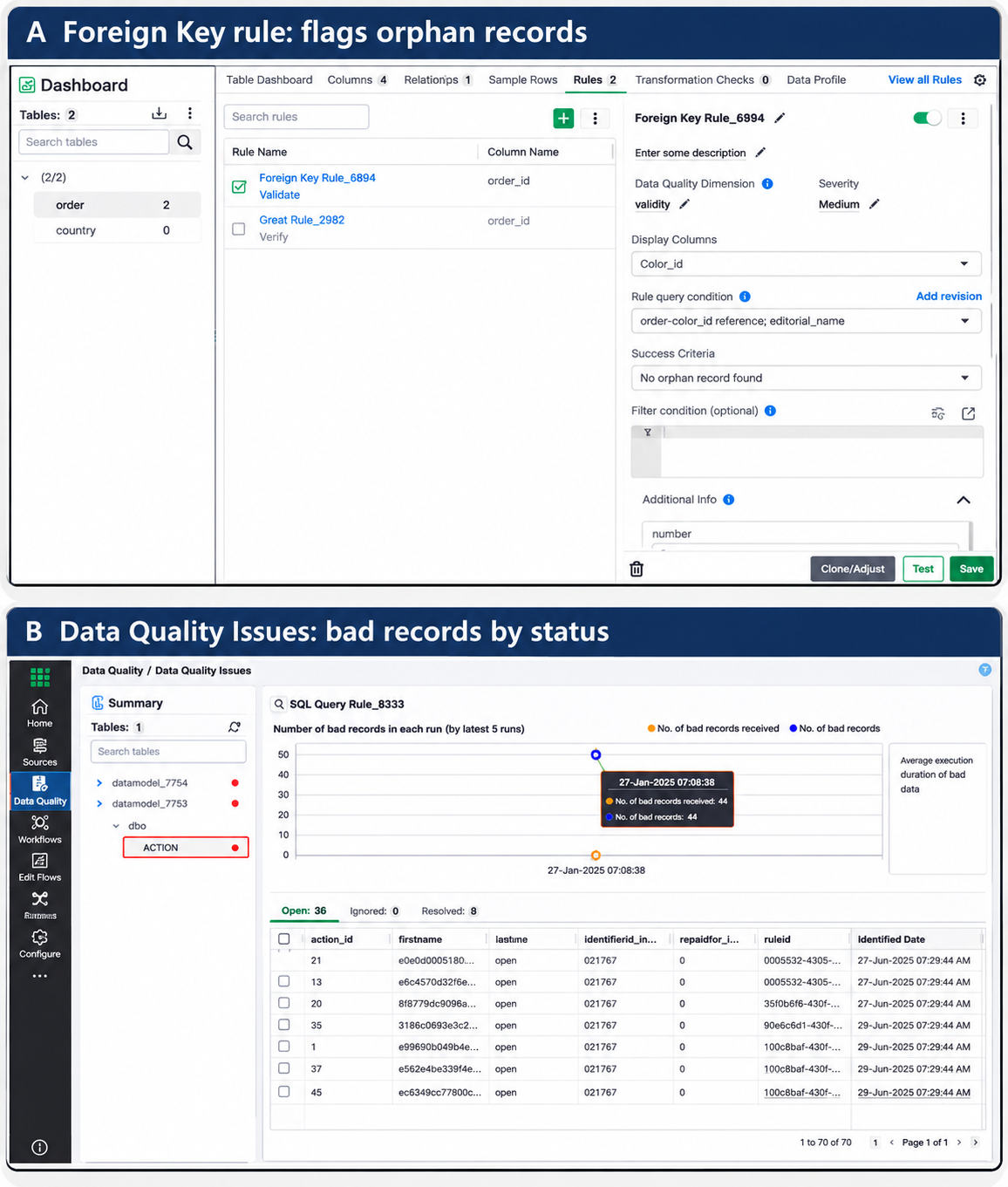
| Orphaned records | Children load before parents, or parents are deleted | Control load order and enforce constraints where possible. Detect with the Foreign Key rule in DataOps Data Quality or an SQL Query rule in ETL Validator | Fix load order and handle late parents |
| Conflicting data across systems | Applications define or update the same entity differently | Agree one system of record. Detect with Cross Source Compare against a golden dataset | Reconcile the difference and align definitions |
| Unowned or manually edited data | Nobody owns a table, and edits bypass the pipeline | Assign table owners and restrict write access. Detect with Data Rules and Data Compare against the source of record | Assign an owner, correct the data, and close the gap |
Each row is a test you can automate. If a source team changes order_id from integer to text, the load can still succeed because values cast, but joins and keys behave differently; Metadata Compare and the Schema Drift view flag the change before anyone reads a report. If a payment event stamped 11:58 p.m. arrives at 12:10 a.m., after the daily load, yesterday’s revenue stays understated until the window is reprocessed, and Metrics Compare on that window shows the gap.
If a CRM and the warehouse disagree on active customers, Cross Source Compare against a golden dataset shows which group differs. Start with the challenge that has already reached a report.
How Does ETL Testing Automation Catch Data Integrity Risks Early?
It adds a detection layer to the controls you already have. Think in three layers: prevent, detect, and respond.
- Prevent: enforce constraints and unique keys where the source allows, make loads repeatable, version mappings, and assign a table owner.
- Detect: run comparison and rule checks on every load and release, and watch for source changes. In ETL Validator, Data Compare, Metrics Compare, Metadata Compare, and Data Rules do this work, and a Foreign Key rule in DataOps Data Quality covers orphan records. Generate the comparison queries from mapping documents, review them, and call the dataflow from CI/CD through the command line or REST API.
- Respond: route each failure to an owner, assess the impact, fix the cause, and keep the passing rerun as evidence, as the next section shows.
See ETL testing automation: from mapping documents to reviewed tests for the generation workflow, ETL testing automation in practice for a worked example, and how to choose data validation tools to compare approaches.
What Should You Do When a Data Integrity Test Fails?
A failure needs an owner, a record of what broke, and a path to resolution. In DataOps Data Quality, records that fail a rule are written to a workschema in PostgreSQL or Snowflake, each with a checksum tied to the rule execution. The Data Quality Issues screen lists those bad records with a status of Open, Resolved, or Ignored, charts the bad records in each run, and reports average resolution time. Table owners are assigned in the Data Model (Figure 2).
Before fixing, use Impact Analysis in the Data Catalog to see which dataflows, business rules, and data models a changed column affects. Then fix the cause, not just the records: update the mapping, the load order, or the rule, rerun the dataflow, and keep the passing run as evidence. A failed batch run can open a Jira ticket, and audit logs record who ran or changed what. Teams in life sciences, healthcare, and financial services need that trail for inspections and audits.
Conclusion: How Do You Stop Data Integrity Challenges Reaching Reports?
Data integrity challenges come from change and movement, so the defense is detection at each stage: structure, records, relationships, and totals. Map each challenge to a check, automate the checks so they run on every load, and track each failure to resolution.
ETL Validator and DataOps Data Quality, part of Datagaps DataOps Suite, cover these checks and keep the evidence. For platform moves, see data integrity testing during data migration and data migration testing automation.
Frequently Asked Questions
What Are Common Causes of Data Integrity Issues?
Schema changes, retried or partial loads, transformation errors, load-order and late-data problems, and manual edits to source data. Most pass silently because the job completes.
How Do You Detect Data Integrity Problems Early?
Run comparison and rule checks on every load: compare metadata and records between source and target, check keys and relationships, and reconcile totals. Automating them makes a defect fail the run that caused it.
Who Owns Data Integrity?
Ownership is shared. Data engineers own pipeline logic and tests, QA owns coverage and evidence, and business data owners define the rules and accept exceptions. DataOps Data Quality lets you assign table owners for issue tracking.
What Is the Difference Between Data Integrity and Data Quality?
Data integrity is the completeness, consistency, and accuracy of data as it moves and changes. Data quality is a broader measure of fitness for use. See data integrity vs data quality.
Can Automated Tests Catch Unknown Data Integrity Risks?
Rules catch the failures you anticipate. For unknown problems, such as shifts in freshness, volume, or distribution, add observability, as described in monitoring unknown data issues.
Book a personalized 30-minute demo and bring one pipeline,
or start a 14-day free trial.

RajMohan Achanta
Senior Associate Product Manager, Datagaps
Senior Associate Product Manager at Datagaps. Shapes the product experience across ETL Validator, BI Validator, and DataOps Data Quality.

Avinash Keshri
Head, Product Marketing
Head of Product Marketing at Datagaps and IIM Bangalore alumnus. 13+ years of experience in commercializing AI and data platforms across global markets.


