
Join Us at Trusted Data Summit themed on "Trusted Data-AI Ready Outcome" on Nov 19th 2026 at 09:30 EST

DataOps Suite
The complete platform
DataOps Data Quality
Agentic Data quality tool
ETL Validator
ETL, ELT and migration testing
BI Validator
Dashboard and report testing
Test Data Manager
Compliant synthetic test data
Platform Overview
See how it works

DataOps Suite

Data Quality and Agentic AI platform that validates, reconciles, scores, monitors and remediates data from ingestion to BI and AI.

Why one platform

Agentic AI-powered test and rule creation
Agents generate data quality rules, validation tests and SQL from prompts, with your approval.
Data quality score per dataset
Shows the current score, what changed since the last run and the failing records behind it.
Validation and observability inside the pipeline
Every load is compared with its source, transformations are tested against business logic, and freshness, volume and schema changes are monitored.
Reports that match the source
Dashboard figures are compared with the source data behind them before users see them.
Test data without real records
Synthetic data that mirrors production replaces sensitive records in test environments.
Quality gates for releases
Pipeline and report changes are tested before they go to production.

DataOps Data Quality

Continuously profiles, validates and scores enterprise data, with Agentic AI that recommends rules and flags anomalies, so analytics and AI run on trusted data.

Capabilities

AI-recommended DQ rules and scoring
Agents suggest completeness, validity and uniqueness rules, with scores down to the column.
Data profiling
Analyzes distributions, patterns and frequencies to surface outliers.
AI-based observability
Agents monitor pipelines end to end, detect anomalies and suggest fixes.
Data catalog
Organizes models and tables in one catalog, with AI-drafted descriptions.
Data lineage
Traces data from origin to destination through every transformation.
Data quality issue tracking
Assigns every failing record to an owner and tracks it to resolution.

ETL Validator

Automates ETL/ELT testing, with Agentic AI that builds tests from mapping docs, confirming every record arrives complete, accurate and correctly transformed.

Capabilities

AI-generated ETL tests
Turns mapping docs into checks for joins, transforms and edge cases.
Source-to-target validation
Matches loaded data to the source, down to record counts and required fields.
Transformation validation
Verifies business logic with SQL, Python or Scala.
Migration validation
Checks schema, row counts and integrity for cloud migrations.
Metadata change audit
Catches schema and metadata discrepancies before they break pipelines.
Root cause and adaptive tests
Pinpoints where data broke, and agents update tests when mappings change.

BI Validator

Automates testing and governance for Power BI, Tableau and Oracle Analytics, with Agentic AI that builds tests from plain English and keeps reports accurate and reliable.

Capabilities

AI-created BI tests
Describe a test scenario in plain English, and agents build it.
Visual-to-source comparison
Compares the data behind every visual to the source using auto-generated SQL.
Regression and upgrade checks
Pixel-level comparisons across environments, with AI summaries of what changed.
Measure logic checks
Converts BI measures and calculations to SQL to confirm KPI logic.
Performance and load testing
Simulates concurrent users and measures load and refresh times.
BI governance
Finds unused measures, duplicate reports and orphaned tables.

Test Data Manager

Uses Agentic AI to detect and mask sensitive data and generate synthetic data that mirrors production, so teams can test without exposing real records.

Capabilities

AI synthetic data generation
Learns patterns from a small sample to create production-like data.
PII discovery and masking
Detects PII and PHI and replaces it with realistic fake values.
Relationship-aware data
Keeps linked tables connected with referential integrity.
Millions of records in minutes
Scales for load, stress and performance testing.
Multi-format output
CSV, Parquet or JSON, or loaded straight into test databases.
Compliant by design
Cloud or on-prem, supporting GDPR and HIPAA requirements.
Data Quality Use Case
The problem to solve
Cloud platforms
Warehouses, lakes and CRM
BI and analytics
Dashboards and reports
ROI calculator
Estimate the time and cost you’ll save.
Financial services
SOX, BCBS 239 and NAIC MAR
Healthcare
HIPAA, EHR migration and APCD
Life sciences
GxP and 21 CFR Part 11
Manufacturing
ERP migration and supplier data
Retail and utilities
Settlement, pricing and NERC CIP
Higher education
FERPA, IPEDS and research data

Banking, Financial Services, and Insurance (BFSI)

Stop reporting errors before examiners find them, with every number traced from core system to board dashboard.

How Datagaps helps

Core platform migrations
Cut over banking and insurance platforms, including mainframe to cloud, without losing a record.
Regulatory reporting
Hold submissions until the data meets quality thresholds.
Financial reconciliation
Match GL to subledger automatically, with every break flagged.
Risk and credit data
Catch drift before risk, lending and pricing models degrade.
Dashboard attestation
Prove capital and board dashboards match the warehouse.

Healthcare

Keep claims and clinical data accurate through every migration, without exposing patient records in testing.

How Datagaps helps

EHR migrations
Confirm every record survives the move to Epic, Cerner or Oracle Health.
Claims data quality
Catch errors in claims and remittance feeds as they arrive.
APCD submissions
Check every file against state templates before you submit.
Clinical dashboards
Catch KPI and report changes after every refresh.
Provider directories
Keep provider listings accurate, current and audit-ready.

Life Sciences

Catch issues in clinical and real-world data before submission, and keep trial subject data out of test environments.

How Datagaps helps

Clinical data migrations
Move EDC, CTMS and LIMS data to the cloud without losses.
CRM migrations
Keep rebate calculations right through Veeva and Salesforce moves.
Pharmacovigilance data
Catch adverse event data issues before regulatory submission.
Commercial and clinical dashboards
Trace every KPI back to source clinical and lab records.
De-identified trial data
Keep subject data out of test, analytics and AI environments.

Manufacturing

Avoid broken ERP cutovers and supplier overpayments, and catch sensor drift before it hits production.

How Datagaps helps

ERP migrations
Move BOM, inventory and financial data across Oracle, SAP and cloud without breaks.
Supplier reconciliation
Catch overpayments and duplicate invoices with three-way PO, ASN and invoice matching.
Sensor data quality
Catch drift before it skews predictive maintenance and yield models.
Operations dashboards
Catch report breaks after every release or upgrade.
Safe ERP test data
Keep supplier pricing and production volumes out of lower environments.

Retail and Utilities

Catch settlement, inventory and pricing errors before your customers or regulators do.

How Datagaps helps

Settlement reconciliation
Match marketplace payout files to the general ledger, record by record.
Inventory accuracy
Keep POS, ERP and warehouse numbers in sync.
Pricing and promotions
Catch price and promotion mismatches across channels.
Reliability dashboards
Keep SAIDI and SAIFI reliability reporting accurate.
BI under load
Make sure reports hold up for thousands of concurrent users.

Higher Education & Research

Get enrollment, financial-aid and transcript data right before SIS cutover, before students feel it.

How Datagaps helps

SIS migrations
Validate moves from Banner or PeopleSoft to Workday Student or Ellucian.
Financial-aid reconciliation
Match aid and Bursar data to the general ledger.
Enrollment reporting
Keep census and admissions dashboards consistent from cycle to cycle.
Federal reporting
Monitor data quality ahead of IPEDS submissions.
Safe student data
Test and train AI without exposing real student records.

Trusted Data Summit

A practitioner summit focused on the validation, observability, governance, and reconciliation practices that determine whether enterprise data is ready for AI.

Save Your Spot
Nov 19th, 2026
Technology Partners
Cloud, data and BI platforms
SI Partners
Consulting and implementation

Become a partner

Resell, implement or co-deliver

Technology Partners

Datagaps works natively with the cloud, data and BI platforms your teams already run.

Our technology partners

SI Partners

Consulting and integration firms that deliver Datagaps validation for enterprise clients worldwide.

Our SI partners

Solutions

Use cases

Cloud platforms

BI and analytics

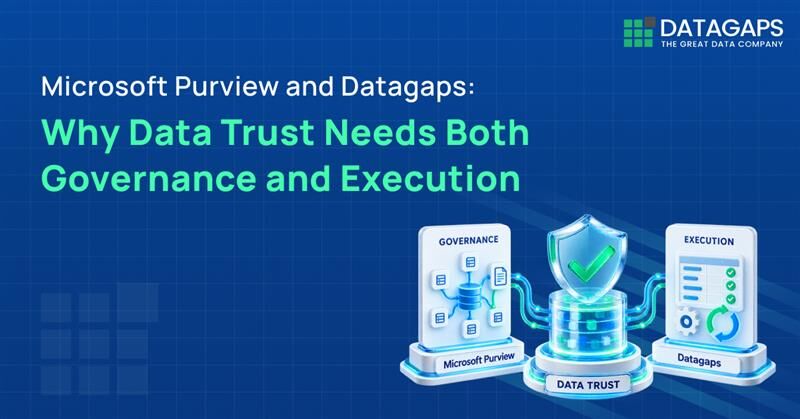
Microsoft Purview and Datagaps: Why Data Trust Needs Both Governance and Execution

Microsoft Purview and Datagap Why Data Trust Needs Both Governance and Execution

Enterprise data trust is a measurable state in which organizations can verify that their data is accurate, governed, and continuously validated across every stage of the pipeline. Achieving it requires two complementary layers: a metadata governance layer (such as Microsoft Purview) for visibility and policy, and an operational execution layer (such as Datagaps DataOps Suite) for automated testing, quality scoring, and validation. Neither layer alone is sufficient. 

Key Takeaways

  • Metadata governance shows what your data is and where it lives. Operational execution proves whether that data is actually correct today. 
  • Microsoft Purview handles cataloging, classification, lineage, and compliance policies across your data estate.
  • Datagaps DataOps Suite handles automated ETL validation, transformation testing, data quality scoring, schema drift detection, and continuous monitoring.
  • Combining both layers creates a complete trust architecture: Purview governs, Datagaps validates.
  • According to Gartner (2025), 60% of data management tasks will be automated by 2027, making this dual-layer approach essential for enterprises scaling AI and analytics.

Why Does Data Governance Alone Not Build Trust?

Enterprises today manage hundreds of data and AI products for both internal operations and external clients. From industry observations over the past three years, projects in their initial stages rarely have a governance layer. In many cases, even mature projects lack one entirely.

Even when governance programs exist, they focus almost entirely on metadata. Assets get cataloged. Sensitive columns are classified. Business glossaries are created. Lineage diagrams begin to show how data moves across pipelines. These are all critical investments. 

But here is the core problem: governance gives you visibility, not proof.

Alt: Microsoft Purview data health controls showing governance metrics for access, discoverability, estate curation, value creation, and trusted data
Microsoft Purview's Data Health Controls provide visibility into governance maturity across six control groupings.

You can catalog every table, classify every column, and trace every lineage path. Yet a random unexpected value can still break your pipeline on any given day. Enterprises simply cannot afford that kind of risk. 

What Is the Difference Between Metadata and Operational Governance?

There is a well-known principle in the data world: metadata tells the story, but data tells the truth. 

Metadata governance answers identity and context questions. Where did this dataset originate? Who owns it? Does this table contain PII? What is the lineage of this report? Which glossary term maps to this column? Which compliance policy applies? 

Operational governance answers health and execution questions. Did today’s pipeline load successfully? Did all expected records arrive? Are there unexpected nulls or duplicates? Did any transformation corrupt the data? Are business rules still passing? Can Finance trust today’s dashboard? 

The distinction matters because you can have perfect metadata governance and still have broken data reaching your dashboards. Governance without execution is visibility without verification.

Comparison diagram showing metadata governance questions on the left mapped to operational governance questions on the right
Metadata governance provides the identity layer. Operational governance provides the health and execution layer. Both are required for data trust.

How Does Microsoft Purview Handle the Governance Layer?

Microsoft Purview provides unified data governance across the entire data estate. It acts as the metadata and policy backbone for enterprises running Microsoft Fabric, Azure Synapse, SQL Server, Power BI, and hybrid cloud environments. 

Purview’s governance capabilities include a Data Catalog with business glossary and asset discovery, a Data Map for lineage and relationship tracking, Data Classification with sensitivity labels and PII detection, Access Governance for permissions and policy enforcement, Compliance and Audit for regulatory reporting, and Data Estate Insights for governance maturity analytics.

Recently, Purview introduced its new portal with advanced capabilities around governance, compliance, and data security. These updates make it a stronger governance backbone than ever, particularly for organizations invested in the Microsoft ecosystem.

However, Purview’s scope is metadata and policy. It tells you what data exists, where it came from, and who should have access. What it does not do is validate whether that data is correct at the record level, test transformations, or catch quality regressions before they reach production dashboards. 

That execution gap is where Datagaps steps in. 

How Does Datagaps DataOps Suite Build the Execution Layer?

Datagaps DataOps Suite is an enterprise data testing and validation platform that automates quality assurance across the full data lifecycle. Listed in both Gartner’s Market Guide for DataOps Tools (October 2025) and Market Guide for Data Observability Tools (February 2026), it provides the operational execution layer that governance platforms like Purview cannot deliver alone. 

Where Purview governs metadata, Datagaps validates data. Here is what the DataOps Suite delivers: 

ETL Validation: Automated source-to-target data validation powered by AI. Validates 100% of records across 200+ data sources, not just a statistical sample. Catches row-level discrepancies, schema mismatches, and transformation errors before they propagate downstream.

Data Quality Scoring: A continuously updated Data Quality Score that quantifies the health of your data estate at any point in time. Tracks completeness, consistency, validity, and timeliness across datasets. 

Transformation Testing: Validates complex transformations across multiple columns and tables while moving data to dashboards or gold layers. This stage determines what eventually becomes visible on reports or gets exposed through APIs. If anything goes wrong here, you end up with incorrect numbers.

Schema Drift Detection: Tracks structural changes across your data sources, whether columns are added, removed, or renamed. Performs impact analysis showing affected tables and columns across data flows.

Datagaps DataOps Suite schema drift detection dashboard showing tables, columns tracked with detailed change history
Datagaps DataOps Suite tracks schema drift across all connected data sources with full impact analysis for every structural change.

Data Contracts: Reusable validation rules that standardize quality checks across similar datasets. Instead of recreating checks for every new pipeline, Data Contracts enforce consistency at scale.

BI Validation: Automated testing of Power BI, Tableau, Oracle Analytics, and other BI platforms. Catches report errors and performance issues before business users see incorrect dashboards. Datagaps reduces BI validation time by 70% and accelerates turnaround by 80%. 

Synthetic Test Data: Using the Datagaps Test Data Manager (TDM) module, teams can generate compliant synthetic test data to validate transformations before moving anything into production.

Datagaps DataOps Suite data quality dashboard showing Data Quality Score, Data Models, Data Lineage, and Data Quality Issues
The Datagaps DataOps Suite Data Quality dashboard provides a single view of quality scores, data models, lineage, and active quality issues.

Instead of discovering data issues after a stakeholder reports incorrect values, Datagaps DataOps Suite continuously validates data throughout its lifecycle and sends alerts before incorrect data reaches business users. That is the real objective of operational governance. 

How Do Microsoft Purview and Datagaps Work Together?

The strongest data architectures use both platforms for their native strengths. Purview handles the governance and metadata layer. Datagaps handles the testing and validation layer. Together, they cover the entire data governance and quality lifecycle. 

Architecture diagram combining Microsoft Purview for governance with Datagaps DataOps Suite for validation across the full data lifecycle
Reference architecture combining Microsoft Purview for governance and Datagaps DataOps Suite for execution across the entire data lifecycle.

At the Data Source Layer

Purview tracks end-to-end lineage from source to report. Datagaps DataOps Suite runs ETL Validation across every record, validating transformations using AI and LLM integration capabilities. 

At the Warehouse and Data Mart Layers 

Purview applies business glossary terms, classifies sensitive data, and enforces access policies. Datagaps DataOps Suite continues validation through Data Quality Monitoring and automated testing to ensure the data reaching production data marts is verified. 

At the Reporting and Dashboards Layer 

Purview provides compliance audit trails and data estate analytics. Datagaps DataOps Suite runs BI Validation to verify that the final reports and dashboards reflect accurate, trustworthy data. 

What Additional Capabilities Does the DataOps Suite Offer?

Beyond core data testing, Datagaps DataOps Suite includes several components that extend the execution layer of governance. 

Datagaps DataOps Suite navigation showing Data Quality, Data Models, Dataflows, Pipelines, BI DevOps, TDM, and additional modules
Datagaps DataOps Suite includes over 15 integrated modules covering data quality, DevOps, test data, scheduling, and monitoring.

Data Models provide an abstract model that organizes data elements and standardizes how they relate to one another and to the properties of real-world entities. Data Lineage tracks data as it moves through systems and processes, helping users understand where data originated and how it has changed. Data Quality Issues actively monitors and identifies data points that are inaccurate, incomplete, or failing predefined quality standards.

Data Contracts define reusable validation rules for data files, ensuring all incoming data conforms to expected structure and quality standards. Common Data Models provide high-level organization of data across functional areas. And the Analysis module delivers structured reporting on data quality patterns, enabling teams to identify systemic issues rather than reacting to individual incidents. 

Datagaps DataOps Suite provides Data Contracts, Common Data Models, and structured Analysis for repeatable governance execution.

Where Is Enterprise Data Trust Headed?

Microsoft Fabric enables fast analytics and AI experiences, but reliable outcomes depend on trustworthy data. Datagaps supports Fabric data quality workflows by helping teams generate rules faster, execute validations consistently, and interpret results with actionable detail. This reduces risk, improves reliability, and helps scale data quality practices across teams and environments. 

The future of enterprise data trust will be built on two complementary layers. The first layer focuses on visibility through tools like Microsoft Purview. The second focuses on continuous validation through platforms like Datagaps DataOps Suite. 

According to Gartner (2025), the data observability market is growing at 20.8% annually, reaching $346.4 million. And 53% of data and AI leaders have already implemented data observability tools, with 43% more planning to do so within 18 months (Gartner, 2025). Organizations that invest in both governance and execution will build the data trust foundation required for reliable AI, accurate analytics, and confident business decisions. 

Frequently Asked Questions

How does Microsoft Purview differ from Datagaps DataOps Suite?

Microsoft Purview is a unified data governance platform that handles metadata cataloging, classification, lineage, access policies, and compliance auditing. Datagaps DataOps Suite is a data testing and validation platform that automates ETL validation, transformation testing, data quality scoring, schema drift detection, and BI report verification. Purview governs what data exists. Datagaps validates whether that data is correct. 

Can Datagaps DataOps Suite work alongside Microsoft Purview?

Yes. The two platforms are complementary by design. Purview operates as the metadata and policy layer across your data estate. Datagaps DataOps Suite operates as the automated testing and validation layer. Together, they cover governance from cataloging through to record-level verification, creating a complete trust architecture. 

Does Datagaps DataOps Suite support Microsoft Fabric and Azure?

Datagaps DataOps Suite supports Microsoft Fabric, Azure Synapse, Azure SQL, Azure Data Factory, and SQL Server natively. It also supports over 200 additional data sources including Snowflake, Databricks, Oracle, Informatica, and Amazon Redshift. 

How does Datagaps validate data differently from sampling-based tools?

Datagaps validates 100% of records at the row level, not a statistical sample. Every row, column, and transformation is verified against expected outcomes. Full-coverage validation is especially important for financial data, regulatory reporting, and migration projects where even small anomalies carry outsized business impact. 

Get Started Today

Talk to a datagaps expert

Raj Mohan Achanta
RajMohan Achanta

Associate Product Manager, Datagaps

Associate Product Manager at Datagaps. Shapes the product experience across ETL Validator, BI Validator, and DataOps Data Quality.

Avinash's picture
Avinash Keshri

Head, Product Marketing

Head of Product Marketing at Datagaps and IIM Bangalore alumnus. 13+ years of experience in commercializing AI and data platforms across global markets.

Established in the year 2010 with the mission of building trust in enterprise data & reports. Datagaps provides software for ETL Data Automation, Data Synchronization, Data Quality, Data Transformation, Test Data Generation, & BI Test Automation. An innovative company focused on providing the highest customer satisfaction. We are passionate about data-driven test automation. Our flagship solutions, ETL Validator, DataFlow, and BI Validator are designed to help customers automate the testing of ETL, BI, Database, Data Lake, Flat File, & XML Data Sources. Our tools support Snowflake, Tableau, Amazon Redshift, Oracle Analytics, Salesforce, Microsoft Power BI, Azure Synapse, SAP BusinessObjects, IBM Cognos, etc., data warehousing projects, and BI platforms.  Datagaps

Related Posts:
Download Datasheet
Download Datasheet
Download Datasheet
Download Datasheet
Download Datasheet

Data Quality Monitor

Continuously assess, score, and improve your enterprise data quality using rule-based and AI-powered validation
Automated Data Quality Checks at Scale

Validate uniqueness, completeness, domain accuracy, and detect orphan records.

AI-Driven Anomaly Detection and Alerts

Identify data drift and outliers using ML-based statistical methods and IQR-based profiling.

Low-Code Rule Configuration with Data Rule Wizard

Create and deploy validation rules quickly without coding, even across large datasets.

Graphical Scoring and Monitoring Dashboard

Visualize data quality trends across models, tables, and records with actionable insights.

CI/CD and Cloud Integration Ready

Enable continuous validation across pipelines using integrated APIs and DevOps compatibility.

Test Data Manager

Generate high-quality synthetic test data securely while maintaining regulatory compliance with HIPAA, GDPR, and CCPA
AI-Powered Synthetic Test Data Generation

Automatically create realistic data based on patterns in production while masking PII/PHI.

Reduced Cost and Time for Test Data Preparation

Eliminate manual rule-writing and speed up test readiness for complex use cases.

Support for Diverse Data Formats and Models

Generate millions of records in JSON, XML, CSV, relational, or hierarchical formats.

Secure, Policy-Driven Data Masking

Ensure sensitive fields are protected using deterministic, reversible, or random masking.

Flexible Deployment Across Cloud or On-Prem

Deploy within your secure environment and integrate into automated pipelines seamlessly.

ETL Testing

Maximize the efficiency, quality, and reliability of your data pipelines through intelligent automation, validation, and scalability.
100% Data Validation Across Pipelines

Validate billions of records using Spark-powered parallel execution across on-prem and cloud sources.

Accelerated Migration and QA Cycles

Reduce migration testing time by up to 60% and QA costs by 30% with automated workflows.

Automated Metadata and Transformation Testing

Detect schema mismatches and ensure business rules are correctly applied via AI-assisted validation.

Seamless Collaboration and Governance

Enable role-based access, ALM integration, and shareable web reports to unify cross-team efforts.

Low-Code/No-Code Test Creation with AI

Empower both technical and business users to build, schedule, and execute validations using prompt-based automation.

BI Validator

Ensure accuracy, performance, and security of your Business Intelligence dashboards and reports across platforms like Tableau, Power BI, and Oracle Analytics
Automated Regression Testing Across BI Reports

Detect broken visuals or logic changes post-upgrade and data refreshes.

Cross-Platform Validation of Reports and Dashboards

Compare visuals and data across environments and BI tools with zero manual effort.

Performance and Load Testing for BI Assets

Simulate concurrent user access to measure response times and report load failures.

Access and Security Validation

Ensure only authorized groups have access to the correct records and reports.

Aesthetic and Metadata Change Detection

Identify formatting inconsistencies, filter changes, and layout drift with each release.

Products

product_menu_icon01

DataOps Suite

Intelligent Data Validation and Analytics Testing Platform with Agentic AI.

ETL Validator automated ETL testing tool

ETL Validator

Automated Data Validation and ETL Testing with Agentic AI.

BI Validator automated BI testing tool

BI Validator

Smarter BI Validation For Power BI, Tableau, Oracle Analytics – Accelerated by AI Agents.

Data Quality Monitor software

DQ Monitor

Proactive Data Quality with Agentic AI – Predict, Prevent, Govern.

Test Data Manager software

Test Data Manager

Generate compliant and realistic test data for all your testing needs, enabled by Agentic AI.

×