Data pipeline validation is the practice of checking both the steps and the data of a data pipeline on every run: whether each stage finished, whether the data that moved is complete and correct, and whether the next stage should be allowed to start. It builds on ETL testing, which checks changes, by adding checks on every run. For an ETL pipeline, ETL pipeline validation means doing this for each extract, transform, and load stage.
The DataOps Manifesto puts the idea in one principle: quality is paramount, so analytic pipelines should detect abnormalities automatically and give operators continuous feedback. This guide explains the main approaches and how Datagaps DataOps Suite supports them.
Key Takeaways
- Data pipeline validation checks every run of a pipeline, not just the code that built it, so bad data is caught while it is still inside the pipeline.
- ETL testing and pipeline validation work together: testing proves that a change is correct, and validation proves that each run is trustworthy.
- Choose an approach by where the check runs: inside the pipeline as a step, in the release process as a gate, or on a schedule as monitoring.
- In a DataOps setup, validation steps are part of the pipeline itself, so a failure stops bad data from reaching reports and models.
How Is Data Pipeline Validation Different From ETL Testing?
ETL testing asks whether a change is correct. Data pipeline validation asks whether this particular run produced trustworthy data. You need both, and Table 1 compares them.
| Aspect | ETL testing | Data pipeline validation |
|---|---|---|
| Question it answers | Does this mapping or code change produce the right data? | Did this run produce trustworthy data, and did every step succeed? |
| When it runs | When something changes, such as a new mapping or release | On every run, as steps inside the pipeline, and on a schedule |
| What it checks | Source-to-target comparison, transformations, and metadata | Data at stage boundaries, counts, quality rules, schema changes, and task status |
| If it fails | The release is blocked and the team fixes the cause | Downstream steps stop, the team is alerted, and the failed task is restarted after the fix |
| Who acts | QA and data engineers before release | Data engineers and operations teams on call |
| Evidence it leaves | Comparison reports from test runs | Run history that links each check to its pipeline run, with HTML run reports |
How Do ETL Testing and Pipeline Validation Work Together?
ETL testing runs when something changes and blocks a bad change before it reaches production. Pipeline validation runs on every execution afterwards, because data changes even when code does not: sources add records, files arrive late, and upstream systems change. Testing catches the first kind of problem and validation catches the second. For the testing side, see ETL testing automation: from mapping documents to reviewed tests.
What Does DataOps Change About Data Pipeline Testing?
DataOps applies Agile and DevOps habits to data work: small, frequent changes, automation instead of manual hand-offs, and shared responsibility for quality. For testing, that means three shifts:
- From a phase to a habit: checks run throughout the pipeline, not once at the end of a project.
- From manual to automatic: tests run on every change and every load without anyone starting them.
- From one team to many: data engineers, QA, and operations each own part of the result.
Data pipeline validation is how those shifts show up in practice. The checks become steps in the pipeline, with rules for what happens when they fail.
What Are the Main Approaches to Data Pipeline Testing and Validation?
Four approaches cover most needs. They differ in where the check runs, and most teams use more than one:
- Stage-level checks: validate the data at each handoff, such as after extraction, after transformation, and after load. They find a problem close to where it started. Best for pipelines with many steps.
- End-to-end reconciliation: compare the final target with the original source. It proves that nothing was lost or changed on the way. Best for migrations and critical tables.
- Release gates: run tests in the CI/CD process so that a failing check stops a release. Best for teams that change pipelines often.
- Continuous monitoring: run rules on a schedule against tables that are already loaded, and alert when they fail. Best for catching problems between releases.
For example, a nightly sales pipeline might check row counts after extraction, compare totals after transformation, reconcile the target with the source after the load, and run quality rules on the published table each morning. That is all four approaches in one pipeline.
Researchers at Amazon described this style as unit tests for data: checks written as code that run automatically on every new batch of data (Schelter and colleagues, VLDB 2018).
How Does Data Pipeline Validation Work in a DataOps Setup?
In a DataOps data pipeline, validation steps sit between the data steps and decide whether the pipeline continues. Figure 1 shows the pattern: a pass lets the next step start, and a fail takes the failure path.
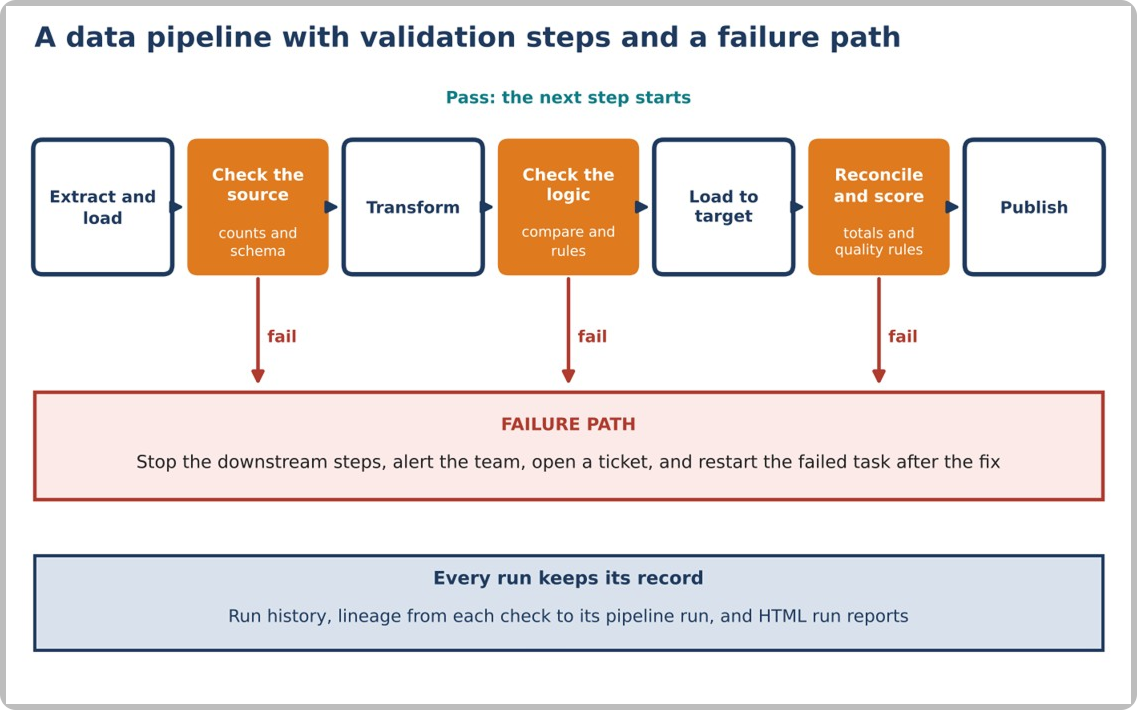
Each gate is a real step in the pipeline. In Datagaps DataOps Suite, validation components such as Data Compare, Cross Source Compare, and Data Profile can run directly inside dataflows and pipelines, and data quality rules can score the result. Every run records its status, timings, and messages, keeps an HTML run report, and links each check back to the pipeline run that produced the data. After a failure, that record answers three questions: which step failed, what it compared, and which earlier run produced the data.
A pipeline’s status and task status can be read through the Status API, and the command line returns a run’s job status, so an orchestrator or release job can decide whether to continue. A failed task can be restarted through the Restart API after the fix, and a failed pipeline run can trigger a notification.
Who Does What in Data Pipeline Validation?
- Data engineers build the validation steps, set the thresholds, and fix failures.
- QA owns coverage: which checks exist, what the expected results are, and whether the rules catch real problems.
- Operations watch the alerts, restart failed tasks, and escalate what they cannot fix.
How Does Datagaps DataOps Suite Support Data Pipeline Validation?
Datagaps DataOps Suite supports each of the four approaches:
- Stage-level checks: Data Profile, Metadata Compare, and Data Compare can run as steps in a dataflow, after extraction, transformation, and load.
- End-to-end reconciliation: Data Compare, Metrics Compare, and Cross Source Compare reconcile the target with the source across systems and engines.
- Release gates: the command line, REST API, and Azure DevOps integration run the checks from the release process, and the command line returns the run’s job status as pass or fail.
- Continuous monitoring: DataOps Data Quality runs rules on a schedule, scores each table, sends email, Microsoft Teams, or Slack notifications, and tracks issues as Open, Resolved, or Ignored. Observability watches for problems no rule anticipates, such as changes in freshness, volume, or schema.
The comparison and rule steps come from ETL Validator. To compare approaches before you choose, see data validation tools for enterprise pipelines.
Our Recommendation: Start With One Gate, Then Add Steps
Pick your most important pipeline and add one validation step after the load that compares the target with the source and applies your key quality rules. Make its result decide whether the pipeline continues, and alert the team when it fails. Once that works, add a check after the source and after transformation, and schedule monitoring for the tables you publish. Datagaps DataOps Suite can run these steps, keep the run records, and report status to your release process. See how it works with CI/CD for data pipelines.
Frequently Asked Questions
What Is Data Pipeline Validation?
Data pipeline validation checks the steps and the data of a pipeline on every run: whether each stage finished, whether the data is complete and correct, and whether the next stage should start. ETL pipeline validation is the same practice applied to ETL pipelines, and it also applies to ELT and other data pipelines.
What Is the Difference Between ETL Testing and Pipeline Validation?
ETL testing checks that a change to a mapping or code is correct, usually before release. Pipeline validation checks every run afterwards, because data changes even when code does not. Most teams need both.
What Is DataOps Pipeline Validation?
DataOps pipeline validation builds checks into the pipeline as steps, with pass or fail decisions, alerts, and run records, in line with the DataOps principle of automated detection and continuous feedback.
What Is Data Pipeline Testing?
Data pipeline testing checks that a pipeline’s logic and outputs are correct, usually before release. Pipeline validation extends it by checking every run.
Book a personalized 30-minute demo and bring one pipeline,
or start a 14-day free trial.

RajMohan Achanta
Senior Associate Product Manager, Datagaps
Senior Associate Product Manager at Datagaps. Shapes the product experience across ETL Validator, BI Validator, and DataOps Data Quality.

Avinash Keshri
Head, Product Marketing
Head of Product Marketing at Datagaps and IIM Bangalore alumnus. 13+ years of experience in commercializing AI and data platforms across global markets.